


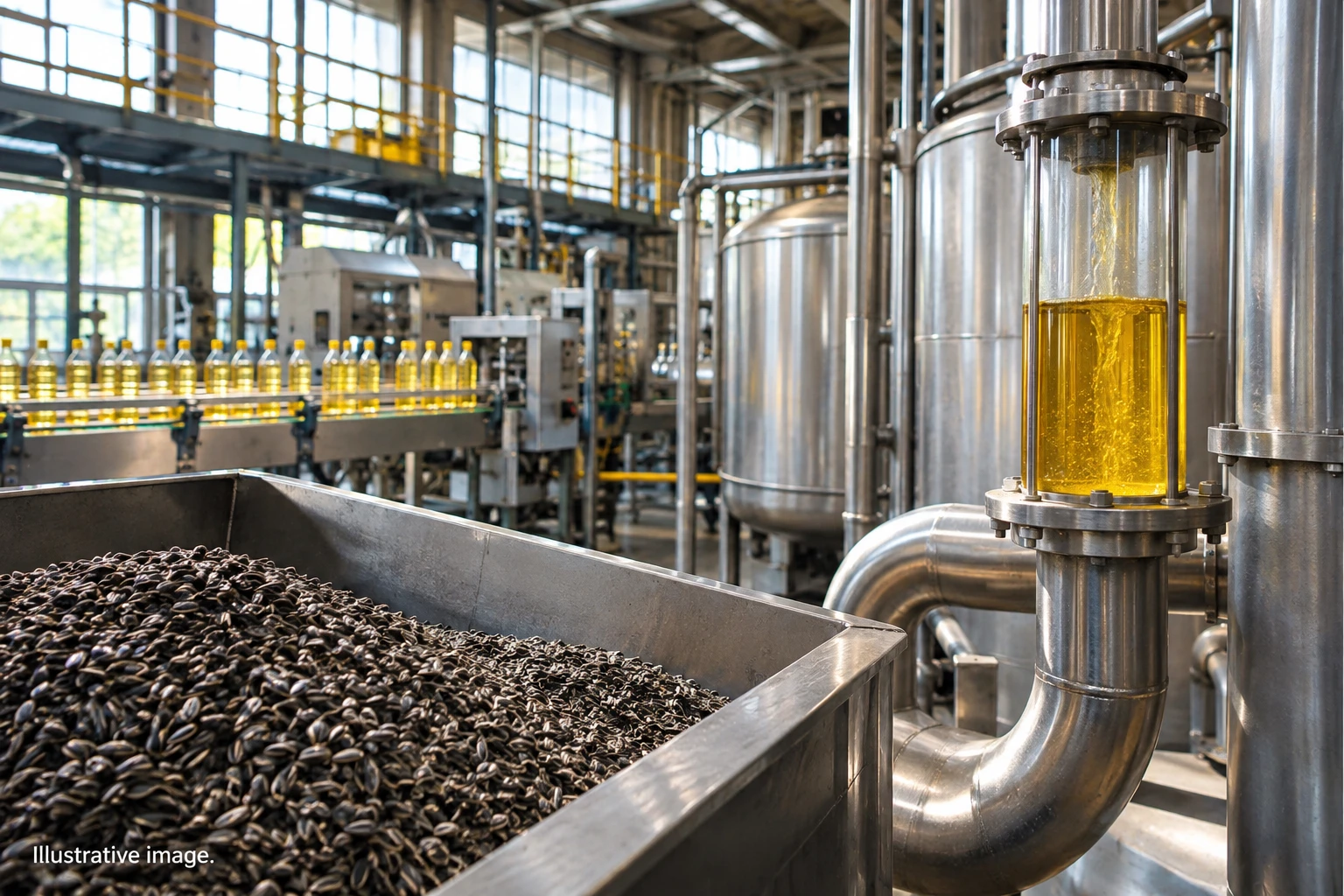
Moldova grows sunflowers, produces and exports oil, but a significant portion of its imported finished products comes from Ukraine. Following Russian strikes on Ukrainian oil extraction plants, this dependence poses an additional risk. At the same time, Moldova exports hundreds of thousands of tons of sunflower seeds annually, which could potentially be processed domestically. Despite having its own raw material base and processing capacity, the country exports sunflower seeds and unrefined oil while simultaneously purchasing finished products. How resilient will the domestic market prove to be amid a decline in Ukrainian production?
On November 12, Kernel, Ukraine's largest producer and exporter of sunflower oil, announced a temporary shutdown of its oil-extraction plants. The shutdown was caused by Russian strikes that damaged production facilities, equipment, and storage tanks. The company operates eight plants with a total processing capacity of 3.5 million tons of seeds per year, although two of these plants have been out of operation since 2022. Kernel has also suspended sunflower seed purchases but continues to ship oil produced earlier. Thus, for now, this is a suspension of production rather than a complete halt to Ukrainian exports.
On November 12, four storage tanks containing a total of 8,500 tons of oil were damaged at a Kernel facility in the Mykolaiv region. One of them was completely destroyed. Continued attacks could delay the resumption of production and limit Ukraine's export capacity.
Military risks are also affecting Moldovan exports. On November 14, the tanker EVIAPETROL V, which was heading to Giurgiulești to load approximately 6,500 tons of sunflower oil from Trans-Oil, was attacked at the entrance to the Sulina Canal near the Romanian coast. The vessel sustained damage and will be unable to complete its scheduled voyage. This is the second such incident in a month involving a tanker carrying Moldovan vegetable oil. Such incidents create risks of delivery delays and additional costs for exporters.
The Moldovan oil and fat industry is entering this crisis following a notable recovery. In the 2025/26 marketing season, the country exported nearly 92,000 tons of sunflower oil worth 2.07 billion lei, compared to 19,200 tons a year earlier. The bulk of these exports came from two companies within the Trans-Oil group: Danube Oil Company in Giurgiulești—36,500 tons—and Floarea Soarelui in Bălți—33,600 tons. Together, they accounted for about 76% of Moldova's total sunflower oil exports. During the best seasons at the beginning of the decade, exports reached 172,000–211,000 tons.
However, Moldova exports much larger volumes not as oil, but as sunflower seeds. According to UN Comtrade international trade statistics, in calendar year 2025, the country exported 661,700 tons of seeds worth $431.7 million. The main buyers were Türkiye—344,000 tons—and Romania—210,300 tons. By comparison, exports of crude sunflower and safflower oil—which had not yet been refined—totaled 62,900 tons, worth $81.9 million.
Thus, a significant portion of the sunflowers grown in Moldova leaves the country without being processed into oil. Along with the raw materials, potential added value—which local enterprises could generate by producing oil and meal—is lost to foreign markets. However, domestic processing is economically viable only if the cost of the finished product covers the costs of raw material procurement, production, and logistics.
According to the National Bureau of Statistics, Moldova's self-sufficiency rate for sunflower seeds reached 261% in 2025. This means that production significantly exceeded domestic consumption of raw materials, but does not indicate a similar surplus of refined and packaged oil.
Moldova has significant processing capacity. According to Trans-Oil, the group's two plants are capable of processing a combined total of up to 620,000 tons of oilseeds per year, producing up to 230,000 tons of oil and 200,000 tons of meal. However, these figures reflect the plants' nominal capacity rather than actual output or available production reserves. Plant utilization depends on the availability of raw materials, processing costs, demand, and existing contracts.
Despite large-scale exports of domestically grown sunflower seeds, Moldovan enterprises purchase seeds from abroad. Part of the growth in oil production during the 2025/26 season was driven by the processing of imported raw materials, including those from Argentina. In the first half of 2026, approximately 58,000 tons of imported sunflower seeds arrived in Moldova by sea. Thus, the export of domestic raw materials and their import for processing occur simultaneously. This may be explained by differences in purchase prices, delivery times, and commercial terms.
However, even an increase in seed processing does not automatically solve the problem of supplying the domestic market. A significant portion of Moldova's exports consists of crude (unrefined) oil, whereas the retail market requires finished food products, including refined and packaged items.
According to international trade statistics, in 2025, Moldova imported 14,400 tons of sunflower and safflower oil, excluding crude oil, of which 13,200 tons, or 91.6%, came from Ukraine. This indicates a high dependence of finished oil imports on Ukrainian suppliers. However, it is not possible to determine the share of Ukrainian products in total domestic consumption based on this data: this would require information on sales of Moldovan-produced oil and possible re-exports.
Dependence on Ukrainian supplies continues into the new marketing season. From July through October 2026, Moldova imported 5,600 tons of sunflower oil, of which about 82%, or 4,600 tons, came from Ukraine. At the same time, the country exported 32,800 tons of oil—77% more than during the same period the previous year. Imports rose by 26%. Exports were nearly six times higher than imports, but this does not eliminate the dependence of certain segments of the domestic market on foreign finished products.
If Ukrainian enterprises resume operations quickly, the consequences for Moldovan consumers may be limited. In the event of prolonged disruptions, importers will have to seek alternative suppliers, primarily in Romania and other European countries. Moldovan producers could also meet part of the demand, but this would require adequate refining and packaging capacity, as well as a financial incentive for enterprises to supply the domestic market.
The interests of processors and farmers may diverge in this regard. Rising global oil prices could increase the profitability of processing but will not necessarily lead to higher seed prices. The shutdown of Ukrainian plants reduces demand for sunflower seeds within Ukraine and may increase the supply of raw materials in neighboring markets.
In early November, purchase prices for sunflower seeds in northern Moldova reached 9 lei per kilogram; however, according to market participants, they subsequently fell to 8.7 lei. That said, trends vary by region: The Ministry of Agriculture estimated the average price as of November 11 at 8.75 lei per kilogram, with a range from 8.2 to 9.3 lei.
If Ukrainian raw materials become cheaper and begin to flow more actively into Moldova, processors will be able to reduce their procurement costs. However, for local agricultural producers, this means increased competition and the risk of lower incomes. A similar situation was already observed during the 2022/23 season, when significant shipments of Ukrainian sunflower seeds were accompanied by a drop in purchase prices in Moldova.
A large-scale shortage of sunflower oil in Moldova seems unlikely in the coming months. The country has its own raw material base, processing facilities, and the option of alternative imports. In the event of a protracted crisis, there could be supply disruptions for certain Ukrainian brands and a reduction in product variety. The extent of the impact will depend on how long Ukrainian plants remain shut down and the availability of stockpiles.
The main risk for Moldova is not that the country will run out of sunflower oil, but rather that, despite having its own raw materials and a processing industry, consumers will have to pay for finished products at prices driven by the crisis in foreign markets. And the longer Ukrainian plants remain idle, the more likely this will affect the shelves of Moldovan stores. // 17.11.2026 – InfoMarket.