



The National Bank of Moldova raised its benchmark rate by 1.5 percentage points in one go: from 7.5% to 9% per annum. Over the past nine months, the cost of money set by the NBM has changed even more dramatically: in December 2025, the rate was lowered to 5%, but in May 2026, a new cycle of tightening began, first rising to 6.5%, then to 7%, to 7.5% in August, and now to 9%.
This marks a shift from the relatively loose monetary conditions of late last year to significantly more expensive money. For banks, the NBM's signal is gradually translating into higher deposit and loan rates, and for the economy, it means higher costs for financing consumption, construction, working capital, and investments.
The reason for this shift is inflation. In August, the annual inflation rate stood at 6.96%, exceeding the upper limit of the 3.5–6.5% range set by the NBM. The National Bank itself attributes the intensification of inflationary pressures to a combination of external supply-side factors—such as rising global prices for energy, food, and raw materials—and domestic demand, supported by household incomes. At the same time, the NBM raised its assessment of inflation risks for the fourth quarter of 2026 and the first half of 2027.
The structure of inflation reveals the extent of price pressures from the energy and transportation sectors. In August, fuel and combustibles cost 28.03% more than a year earlier, passenger transportation services were up by 28.01%, and electricity prices rose by 23.65%. By comparison, food prices rose by 4.74% over the year.
The trends over the past two years show how sharply monetary policy has changed amid shifts in inflation and its forecast. The chart shows the base rate as of the end of the respective month; for September 2026, the NBM's decision dated September 17 is shown, while the inflation rate is the most recently published figure, for August. Inflation data is from the National Bureau of Statistics; data on the base rate is from the NBM.
Trends in Annual Inflation and the NBM Base Rate (September 2024 – September 2026)
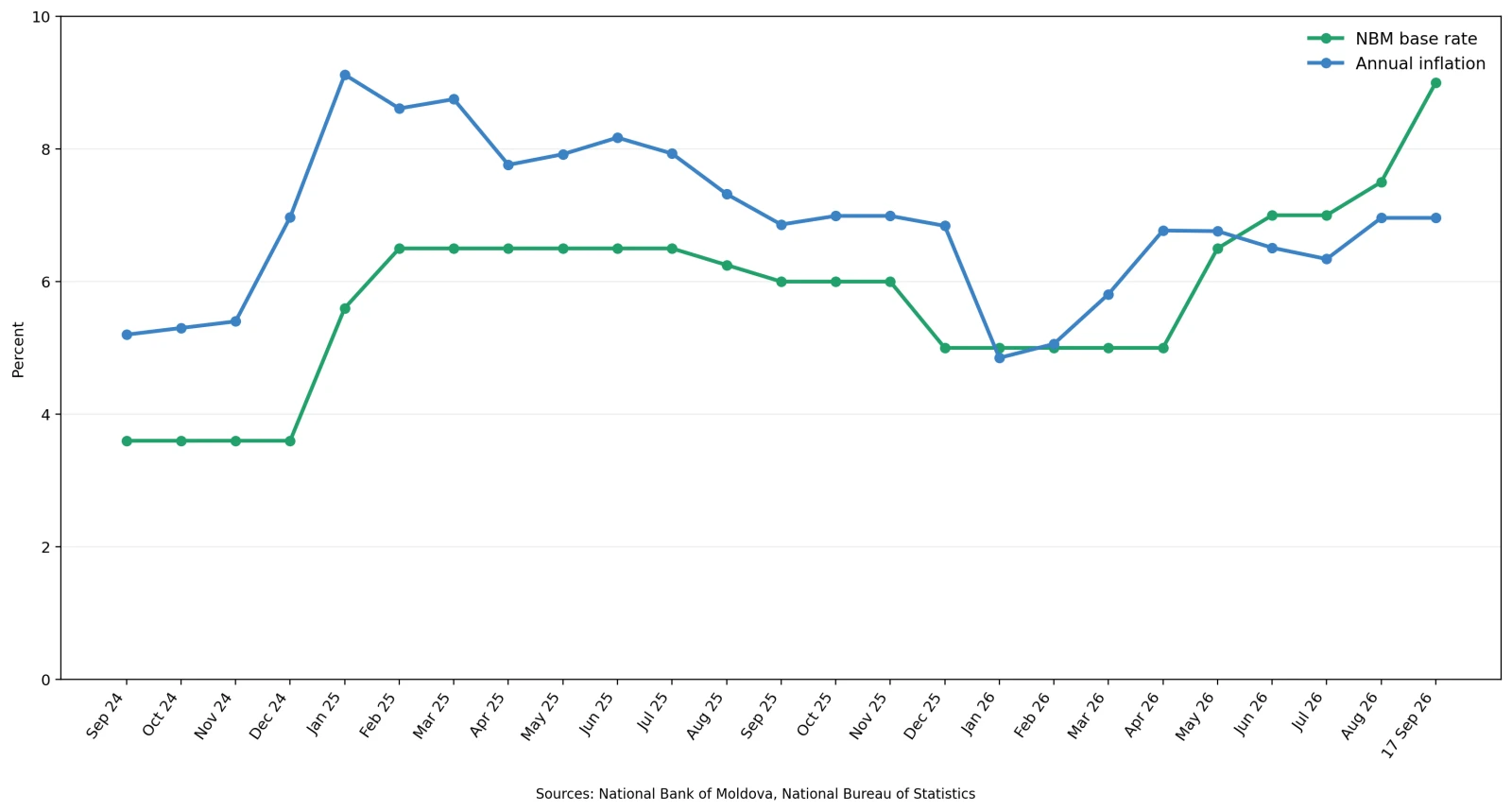
The latest available inflation data is for August 2026.
The graph illustrates an important feature of the NBM's policy. The central bank does not react mechanically to the current inflation figure. In early 2025, when annual inflation exceeded 9% following an energy shock, the rate was quickly raised to 6.5%. When inflation began to decline toward the end of the year, the NBM gradually lowered the rate to 5%. But by the spring of 2026, when inflationary pressures intensified again, this cycle had to be reversed. Currently, the base rate is already about 2 percentage points higher than the most recently published annual inflation rate: 9% versus 6.96%. Herewith, the NBM focuses not only on current inflation but also on its expected trajectory.
But to what extent can a rate hike actually combat inflation, the source of which lies largely outside Moldova?
The base rate cannot lower global prices for gas, oil, or food, increase the supply of energy resources, or resolve disruptions in international supply chains. Therefore, the NBM is not attempting to directly address the initial external price shock. The goal of monetary policy in such a situation is different: to prevent a one-time rise in the prices of energy and imported goods from triggering a more prolonged inflationary chain reaction within the economy.
If, following a rise in fuel prices, transportation costs increase, followed by corporate prices, wage demands, consumer demand, and inflation expectations, the initially external shock gradually transforms into domestic inflation. It is precisely these secondary effects that the NBM is trying to limit through tight monetary policy: to reduce credit demand, encourage savings, and convince businesses and the public that the acceleration in prices will not become permanent. In its September 17 decision, the National Bank explicitly states that the rate hike is intended to mitigate the secondary effects of supply shocks, encourage savings at the expense of consumption, and anchor inflation expectations.
But such a policy comes at a cost. The more inflation is driven by external factors, the less the base rate can directly influence the source of price increases. The NBM is forced to influence the part of the economy it can control—namely, credit, consumption, savings, and investment—in order to limit the consequences of rising prices, the source of which it cannot control.
Meanwhile, this creates the risk of an excessive economic slowdown. In the first half of the year, Moldova's GDP grew by only 0.6%, with total gross value added remaining virtually unchanged. Against this backdrop, a 9% interest rate places additional pressure on an economy that is already barely growing. The longer the NBM is forced to keep interest rates high, the more the anti-inflationary policy will conflict with the goal of sustaining investment and economic activity.
The effects of previous rate hikes have not yet fully reached borrowers. Monetary policy operates with a lag: there is a time lag between the National Bank's decision and its full reflection in bank loans. Therefore, the current 9% rate does not mean that loans will automatically become 1.5 percentage points more expensive tomorrow. Each bank has its own cost of funds, liquidity, risk assessment, and margin. But the trend is becoming clear: the longer the high rate persists, the more it will affect the cost of new loans and the refinancing of existing ones.
Working capital loans are becoming particularly sensitive for businesses. A company that regularly relies on bank financing to purchase raw materials, goods, or cover seasonal expenses will feel the rise in the cost of money more quickly than a business that has already secured a long-term loan at a fixed rate. With more expensive short-term financing, companies may try to pass on part of the additional interest expenses to the cost of their products, while the rest will have to be offset by reducing their own margins.
The impact on investments is even more significant. A project that was economically viable with a loan at 8–9% per annum may become less attractive when the cost of debt capital is significantly higher. Companies may postpone production expansion, construction, and equipment purchases, or switch to financing projects primarily with their own funds. A high base rate cools demand but simultaneously slows investment activity.
For consumers, the most obvious impact is on mortgages and consumer loans. An increase in the base rate gradually makes new loans more expensive while simultaneously increasing the attractiveness of deposits. For existing borrowers, the consequences depend on the terms of their loan agreements. For a fixed-rate loan, the payment does not change solely due to a change in the NBM's base rate. For a variable-rate loan, the cost of servicing the loan may change at the next review in accordance with the formula specified in the specific loan agreement.
Moldova faces a difficult economic trade-off. A significant portion of the new inflationary pressure does indeed come from outside the country. The NBM is unable to eliminate its source but must prevent this shock from turning into sustained domestic inflation. Now everything depends on whether the National Bank will succeed in containing the secondary effects of rising prices without stifling economic growth, which is already weak.
If the external shock subsides, inflation expectations remain stable, and the policy rate can be lowered again relatively quickly, the cost of such a harsh measure to the economy will be limited. If, however, high energy prices persist for a long time and the NBM is forced to keep the rate near its current level for an extended period, the fight against imported inflation will increasingly come at the cost of more expensive loans, deferred investments, and weaker domestic demand. //18.09.2026 – InfoMarket.