


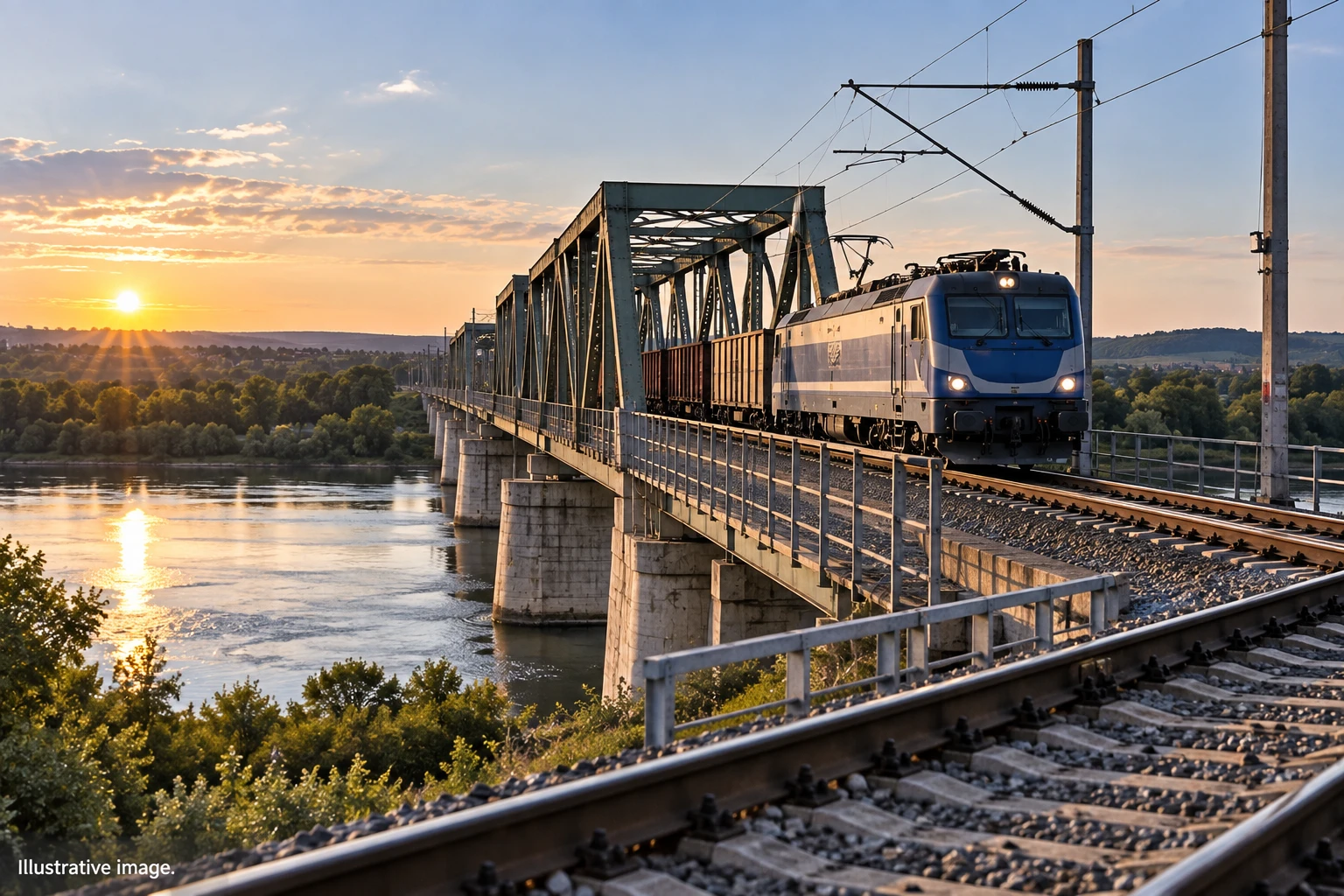
Moldova is moving from plans to integrate its railway with the European network to its first practical project. "Moldova Railways" (CFM) has announced a tender for the design and construction of the Iași–Ungheni section: on the Moldovan side, the railway bridge over the Prut River, the infrastructure of Ungheni Station, and its track bed—all to be converted to the European gauge of 1,435 mm—are to be modernized, and the section from the border to the station is to be electrified.
The significance of the project lies not in the length of the section. Moldova's railway network was historically built primarily on the 1,520-mm broad gauge, whereas the standard for most of the European Union is 1,435 mm. Because of this, trains cannot freely cross from the Moldovan network into the Romanian one without additional procedures at the border.
The idea of gradually changing this system is not a recent one. After the war in Ukraine began, the importance of Moldova's rail connections with the EU increased dramatically: routes through the country were incorporated into the system of European "solidarity corridors," created in part to provide alternative routes for transporting Ukrainian cargo.
In 2023, the European Commission and the European Investment Bank presented a study on the integration of Ukraine's and Moldova's railways into the European transport network. For Moldova, the Iași–Ungheni–Chișinău corridor was identified as one of the top priorities. On the Ungheni–Chișinău section, the option of retaining the 1,520 mm broad-gauge line while simultaneously constructing a 1,435 mm European-standard track was considered. This would allow for the development of a new route without disrupting the existing network.
In the same year, 2023, Moldova joined the European Connecting Europe Facility (CEF), gaining access to EU funding for transportation projects.
The first concrete step was the Iași–Ungheni cross-border project, which does not include extending the railway to Chișinău. In 2025, the European Commission approved funding for the project through the Connecting Europe Facility: the maximum EU contribution is 33.8 million euros. The project involves the modernization and electrification of approximately 25 km of railway from Iași to Ungheni. On the Moldovan side, the work covers only the section from the border to Ungheni Station, including the bridge over the Prut River and the station infrastructure. The project is scheduled for 2025–2029. The Ungheni–Chișinău European-gauge line is a separate future project that is currently in the feasibility study phase.
The Iași–Ungheni project has now reached the stage of procuring construction work. The tender announced by CFM is valued at 5.621 million euros, excluding VAT. Bids will be accepted until October 14, and the contract is scheduled to be completed by February 2029.
The work includes the reconstruction of the bridge over the Prut River, the modernization of Ungheni Station's European-standard passenger rolling stock with a 1,435 mm gauge, electrification using a 25 kV, 50 Hz system, as well as the upgrade of signaling, centralization, communications, and utility networks.
However, the European-gauge track does not yet extend to Chișinău. The European Investment Bank, with support from JASPERS, the joint expert program of the EIB and the European Commission (Joint Assistance to Support Projects in European Regions), is conducting a preliminary feasibility study for the electrified European-gauge Ungheni–Chișinău line, approximately 108–110 km in length. In previously presented materials, the estimated cost of such a project was approximately 344 million euros.
According to Moldovan authorities, the study is expected to be completed in 2026. The plan calls for a fully electrified European-gauge line designed for speeds of up to 140 km/h, with the route extending toward Chișinău Airport. However, no decision has yet been made regarding funding for the construction.
At the same time, Moldova is modernizing its existing 1,520-mm broad-gauge rail network. One of the projects is Moldova Solidarity Lanes, which involves the selective renovation of approximately 128 km of track along the Vâlcănești–Bălți–Ungheni–Chișinău–Căinari corridor, which has a total length of about 370 km. The total cost of the project is estimated at approximately 119 million euros. Signed financing amounts to 53.2 million euros, including a 41.2 million euro loan from the EIB and a 12 million euro grant from the European Union.
A separate project worth 71 million euros is also underway on this same north-south corridor to rehabilitate the Vâlcănești–Bălți–Ungheni and Chișinău–Căinari sections. It is financed by a €23 million EBRD loan, up to €20 million in EU grants, and €28 million in CFM co-financing. Both projects are expected to increase the route's capacity from Moldova's northern border to the southern rail corridor and the Danube ports.
Separately, the Bender–Basarabeasca–Etulia–Giurgiulești line, approximately 233 km long, is being restored. Its cost is estimated at 120 million euros, with projected EIB financing of 54 million euros. This project involves restoring the existing broad gauge track, removing speed restrictions, and increasing the capacity of the route to Giurgiulești.
Thus, the transition to European gauge does not mean a rapid replacement of the entire existing network. In the first phase, the plan is to create separate 1,435-mm corridors while retaining the main 1,520-mm infrastructure.
The economic impact will depend on how far the European gauge extends into the country. For now, it ends in Ungheni: the project primarily modernizes the border railway junction. If the line is extended to Chișinău, European freight and passenger trains will gain direct access to the country's largest economic center without having to change tracks at the border.
The current work in Ungheni is only the first phase of a much larger project. A €5.62 million tender brings the European gauge from transportation strategies to concrete construction in Moldova. // 14.09.2026 – InfoMarket.