


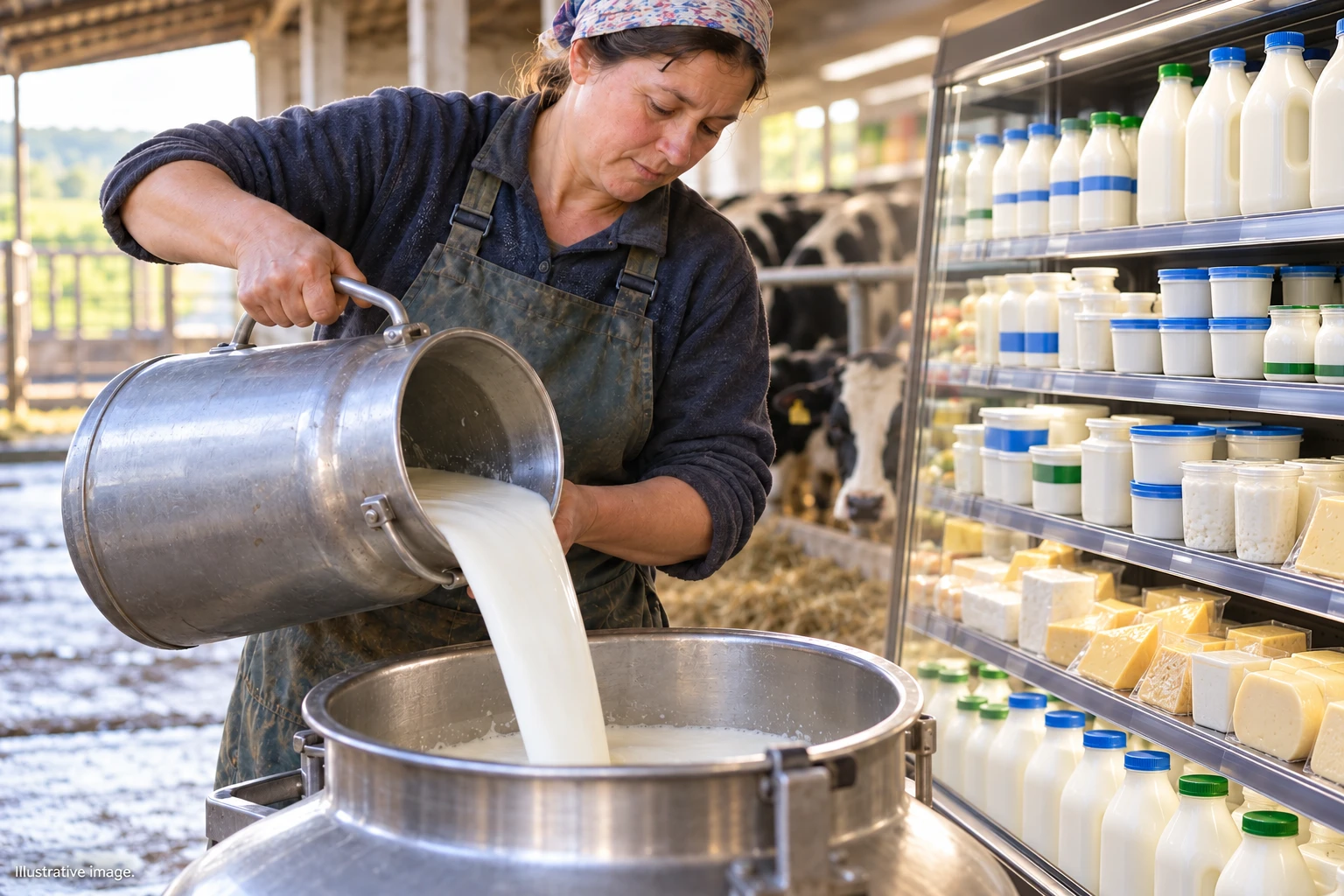
Moldovan dairy farmers are calling for the domestic market to be protected from imported products, but the country does not produce enough milk of its own. Consumers are looking for affordable prices, and foreign suppliers are competing for their business, in part by offering discounts. This dispute involves three challenges: preserving farms, ensuring a steady supply of raw materials for processors, and preventing dairy products from becoming even less affordable. Restricting imports can support sales at local plants, but it will not, on its own, increase milk production or lower production costs.
At a meeting at the Ministry of Agriculture on October 27, representatives of the Lapte Association raised issues regarding competition from products from Ukraine and Belarus, as well as retroactive bonuses in retail chains. A week earlier, on October 20, discussions with the industry focused on bulk milk imports, purchase prices, and production and processing costs. Thus, the matter concerns two distinct types of imports: finished products competing for consumers and raw materials for local enterprises.
The scale of the shortage is illustrated by the food balance sheet from the National Bureau of Statistics (NBS). In 2025, Moldova produced 282,500 metric tons of milk, 15,300 metric tons more than the previous year. Imports of milk and dairy products, expressed in milk equivalent, rose by 27,900 metric tons to 214,700 metric tons. In other words, domestic production increased by approximately 5.7%, imports by 15.9%, and self-sufficiency fell from 59.5% to 57%. Despite the increase in production, domestic milk production covered only slightly more than half of domestic demand.
The structure of the raw material base is also important. According to NBS data, in 2025, private households produced 216,400 metric tons of all types of milk—accounting for 76.6% of the total volume. Agricultural enterprises accounted for 66,100 metric tons, or 23.4%. Meanwhile, production at enterprises grew by 21.7%, while production on private farms increased by 1.7%. Production at agricultural enterprises is expanding, but so far accounts for less than a quarter of national output.
For a processor, total milk yield and available industrial raw materials are entirely different metrics. Milk must be delivered to the plant on a regular basis, meet quality requirements, be chilled, and transported. Part of the output from family farms is consumed by the families themselves or sold directly. Collecting small batches requires separate logistics. Therefore, national production statistics do not fully reflect the amount of milk that a processing plant can purchase to maintain continuous operations.
This gives rise to an internal conflict within the industry. Farmers need a purchase price that covers feed, labor, veterinary care, and herd renewal. Processing plants require raw materials at a price that allows them to compete with finished imported products. Cheaper milk from abroad can help keep processing plants running at full capacity, but at the same time it increases pressure on local dairy farmers. Restricting such raw materials, on the other hand, could support farm-gate prices but increase processing costs. In other words, there is no single formula here that is equally beneficial to all dairy producers.
The high price of local products is also driven by factors beyond the farm. Lapte Executive Director Carolina Linte, in her comments, attributed the higher production costs of local products to small-scale production, energy costs, and the import of packaging and certain ingredients. With low output, the company's fixed costs are spread across a smaller volume of production. If the plant is underutilized, the cost of maintaining equipment and production infrastructure is higher per liter or kilogram sold.
Energy costs exacerbate this pressure: dairy products must be cooled, processed, and stored under controlled temperature conditions. However, attributing the advantage of imports solely to cheap energy would be an oversimplification.
At the same time, high-priced products on the shelf do not necessarily mean high profits for the farm or processor. Between purchasing milk and selling the packaged product to the consumer, there are costs associated with processing, packaging, transportation, storage, and retail.
Competition on the shelves also manifests itself through promotions: suppliers of both imported and domestic products offer discounts. For families on a tight budget, the price on the day of purchase is often the deciding factor.
A separate issue is "retro-bonuses," which were discussed at the ministry. These are payments or discounts that a supplier provides to a retail chain at the end of an agreed-upon period upon fulfillment of the contract terms, such as reaching a certain purchase volume. These should be distinguished from the discounts received by the customer: a reduction in the supplier's revenue does not automatically mean a lower price on the shelf.
It is essential to review the terms of trade: restricting imports will not remedy an unfavorable contract between a Moldovan factory and a store. The additional revenue resulting from reduced competition may remain within the retail sector without translating into higher purchase prices for farms or funds for modernizing processing facilities.
For the government, this means it must assess the consequences separately for each link in the chain. Support for livestock farming should increase the volume of high-quality commercial milk and farm productivity. Support for processing should aim to reduce costs per unit of production, including raw material collection, energy, and packaging. A trade analysis should show how the final price is formed and how revenue is distributed.
Developing the raw material base takes time: new farms, herd expansion, and the organization of regular supplies do not happen simultaneously with the introduction of border restrictions. Therefore, protecting the market without expanding domestic production creates the risk that imports will become more expensive before affordable local substitutes become available.
The buyer cannot continuously compensate the industry for high production costs out of its own budget. But the displacement of local production by cheap imports does not guarantee that prices will remain low in the future. Supporting local producers is important for preserving jobs and tax revenues throughout the entire production chain—from the farm to processing and the sale of finished products. The success of support for the dairy industry should be measured by an increase in the supply of high-quality local raw materials, as well as improved productivity and the availability of finished products. If the only result is higher prices for imported goods, domestic milk will not become cheaper—consumers will simply have fewer affordable options. // 02.11.2026 – InfoMarket.