


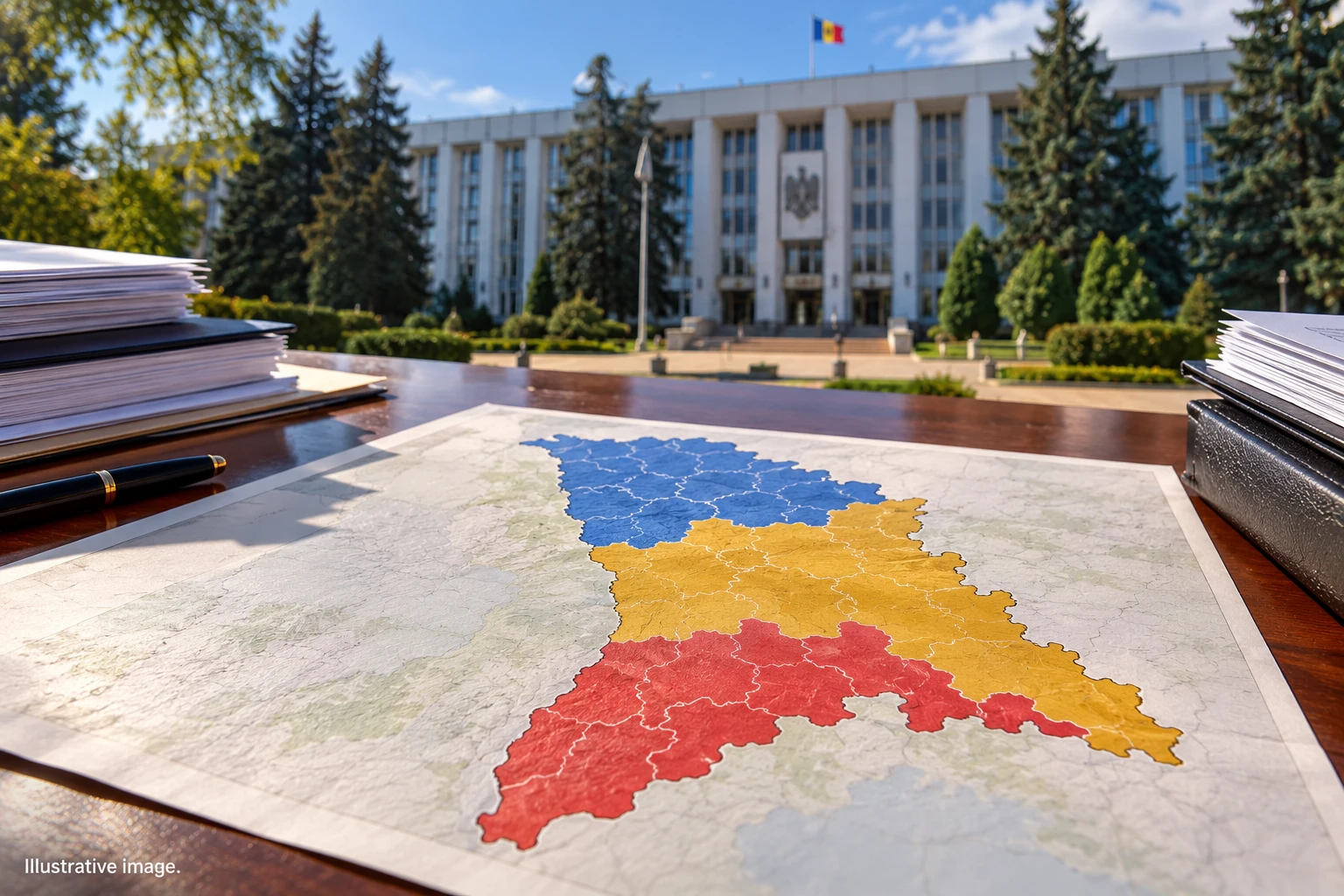
Moldova is preparing for one of the most significant overhauls of its local government system since it declared independence 35 years ago. The current 32 districts are set to be replaced by three large regions: North, Central, and South. Taraclia will be granted second-level municipality status, Chisinau and Balti will retain their current status, and Gagauzia will have special status.
At first glance, the scale of the reform is enormous. In 2025, the combined budgets of the 32 districts totaled about 9 billion lei. At the same time, about 77% of district budgets were allocated to education. These expenditures will not disappear after the districts are abolished: the funds must follow the corresponding functions and be transferred to the institutions that will assume them. The government explicitly states that savings should come primarily from reducing the administrative apparatus and eliminating duplicative structures.
The same applies to a significant portion of the districts' other expenditures. Libraries, museums, cultural centers, art schools, sports schools, youth centers, and other institutions will remain in place and, if necessary, will be transferred to city administrations. Other functions will be transferred to the territorial units of central government agencies. Along with these powers, personnel, assets, and funding must be transferred.
The government promises that the administrative bodies of the three future regions will be leaner than the current district level, but has not yet specified either their projected size or the amount of savings. Therefore, reducing the number of administrative units from 32 to three appears to be a much larger undertaking than the potential cost savings.
But the reform has another dimension—a political one.
Today, at the second level of local government, there are dozens of separate district political arenas, each with its own council, chairperson, and local coalitions. After the reform, these will be replaced by just three regional councils. As early as the 2027 local elections, according to the mechanism presented by the government, citizens will have to vote not for district councils but for regional councils—North, Center, and South. After the elections, the regional council members themselves will determine the region's leadership—the chairperson and their deputies.
Thus, the reform objectively changes the country's political geography. Instead of competing for power in 32 districts, the major parties will vie for control of three large regional councils, each of which will represent hundreds of thousands of residents. According to the proposed plan, the North region will comprise about 514,000 people, the Center about 670,000, and the South about 280,000.
For any incumbent central government, such a system is potentially simpler in terms of political interaction with the regions: instead of several dozen district decision-making centers, there will be three large regional hubs. This could become particularly noticeable during election campaigns, when organizational and party resources will no longer be concentrated at the level of dozens of districts but will instead be focused around the three regional centers—Bălți, Chișinău, and Cahul.
Officially, the government justifies the reform by citing the need to strengthen city administrations, reduce bureaucracy, eliminate overlapping functions, and create regions capable of implementing large-scale infrastructure projects and attracting funding. Political objectives are not mentioned among the stated goals of the reform.
However, the timing is significant. The new administrative model is being created not after the next local elections, but in preparation for them. Therefore, the 2027 election campaign is already expected to take place under a completely different system of local power distribution.
At the same time, the financial outcome of the reform remains unknown. Without knowing the size of future regional administrations and their budgets, it is impossible to determine how much the state will actually save. It is clear, however, that the elimination of 32 districts does not mean the elimination of most of the expenditures that currently pass through their budgets.
However, the political impact of the reform is already evident. Instead of 32 district centers of power, Moldova will have three large regional centers, control over which will carry significantly greater political weight. Therefore, the reform—presented primarily as administrative and financial—is simultaneously changing the dynamics of the political struggle at the local level.
And while the extent of future savings has yet to be calculated, the main political question is already clear: who, after the 2027 elections, will gain control over the three new regions—the North, the Center, and the South. // 03.10.2026 – InfoMarket.