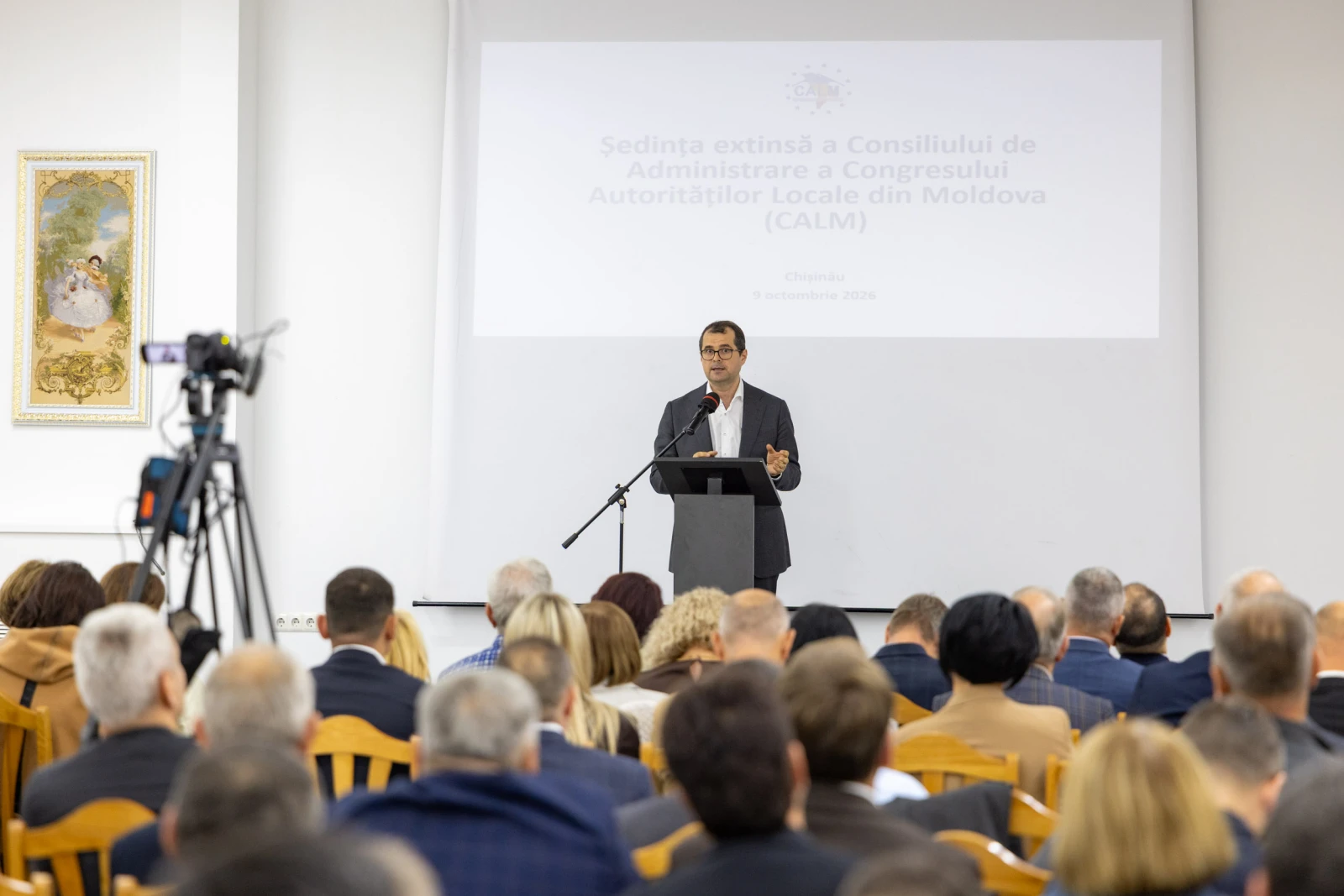
The prime minister made this statement while speaking at an expanded meeting of the Administrative Council of the Congress of Local Authorities of Moldova (CALM). During the meeting, he discussed with representatives of local authorities issues related to public administration reform, strengthening municipal capacity, and preparing local communities for European integration. Vasile Tofan emphasized that local self-government reform is necessary to reduce administrative fragmentation, ensure more efficient use of public funds, and create strong municipalities capable of providing high-quality services to citizens. "If we care about our country, we must understand the need for consolidation. We cannot remain the most fragmented country in Europe. We have chosen the path of voluntary consolidation—a more democratic approach in which the residents and mayors themselves make the decision," the prime minister stated. The head of government noted that the consolidation process is complex and raises questions and concerns among local communities. At the same time, he emphasized that maintaining the status quo is not a solution to the problem, since the administrative costs of some municipalities significantly exceed their own revenues. In this context, the Prime Minister discussed the reorganization of the administrative system at the district level—a transition from 32 districts to 3 regions. According to him, this change will reduce administrative costs, transfer more powers and assets to local communities, and strengthen their autonomy. Particular attention was paid to preparing local authorities for Moldova's accession to the EU and taking advantage of European funding opportunities. "The most important thing is to prepare for the country's accession to the European Union. We won't be able to access structural funding and European grants if we have municipalities with populations of 700, 1,200, or 2,500 people. We must have the capacity to attract and utilize these funds," said Vasile Tofan. Other topics discussed included financial decentralization, strengthening local autonomy, the remuneration of local government employees, and the challenges municipalities face in their operations. The government had previously proposed a new administrative-territorial structure for Moldova: 273 Mayor's offices and 3 regions—North, Center, and South. Chisinau and Balti will retain their status as municipalities, Taraclia will become a second-tier municipality, and the Autonomous Territorial Unit of Gagauzia will retain its special status. The reform plan was discussed with the public during more than 1,200 meetings, in which approximately 115,000 people participated. Citizens can search for any settlement to find out which Mayor's office and region it will belong to, as well as view its projected population. The map is available at primariiputernice.gov.md/harta.// 09.10.2026 — InfoMarket.
Moldova has called for strengthening local self-government to attract European funding
"Moldova needs to establish strong local governments capable of attracting and managing European funds," said Vasile Tofan