


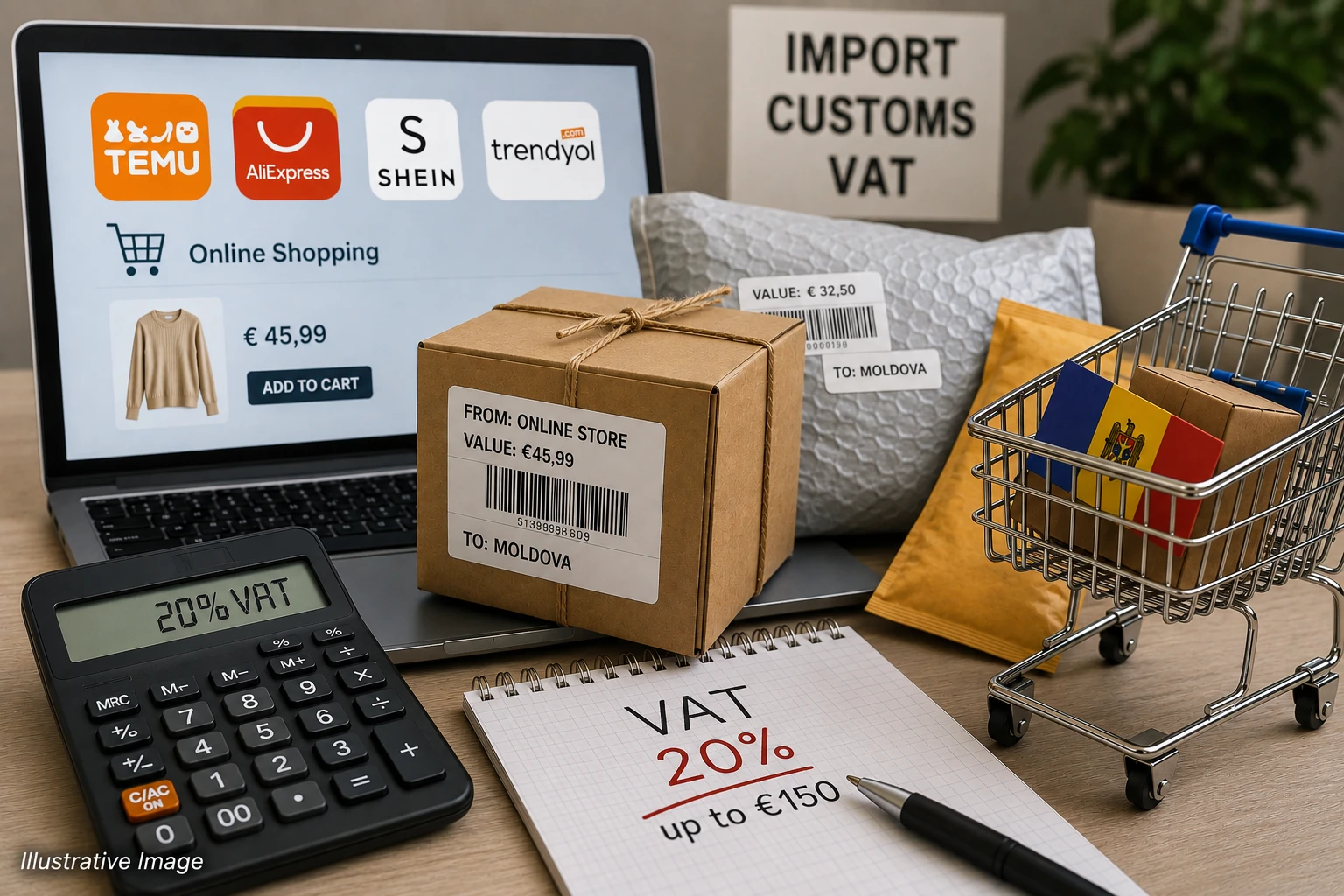
The authorities want to eliminate the tax advantage that foreign marketplaces have over Moldovan retailers. But the new VAT regime for packages worth up to 150 euros will affect more than just Temu, AliExpress, SHEIN, and others. Purchases from European online stores and other international orders—which operate under entirely different sales and taxation models—will also be subject to these same rules. Furthermore, consultations are revealing new complications that could increase the final cost of a package for the buyer.
This week, the Ministry of Finance held consultations with postal and courier operators regarding tax policy for 2027. Topics discussed included VAT on packages, a potential processing fee for each shipment, operators' expenses, customs clearance, storage, traceability of goods, and tighter controls on low-value imports.
The Ministry of Finance's goal is quite clear: to eliminate the preferential treatment for small import purchases and level the playing field between Moldovan sellers and foreign marketplaces.
The problem is very real. Today, a buyer can order goods worth up to 150 euros through Temu, AliExpress, SHEIN, Trendyol, or another foreign marketplace and receive them without paying import VAT. A Moldovan company that imports similar goods for resale does not have this option and must pay this tax upon import.
Against the backdrop of rapid growth in cross-border e-commerce, this disparity is becoming increasingly noticeable. According to previously published data, Temu accounts for about 80% of the packages handled by Poșta Moldovei. But Temu is just the most prominent example.
Starting October 1, 2026, the rules are set to change: online purchases valued at up to 150 euros will be subject to a 20% VAT rate. The 150-euro threshold itself is not new. It already exists in current customs legislation: today, shipments from online stores to individuals valued at up to 150 euros are exempt from import duties, provided certain conditions are met. Packages valued between 150.01 and 1,000 euros are already declared using the H6 electronic customs declaration and are subject to the corresponding import duties. In other words, the new system is intended to eliminate the exemption specifically for that segment of online shopping that has not been taxed until now.
It is expected that large marketplaces will register with the Moldovan system and collect the tax directly at the time of payment for the order. If this does not happen, VAT will have to be paid upon receipt of the package through a postal or courier service.
This levels the playing field: if a Moldovan seller operates under the VAT system, then a foreign marketplace should not receive a tax advantage simply because the goods are delivered directly to the buyer. However, it is precisely the universality of the new rule that has become a source of new controversy.
A collective petition has appeared on the e-Democrație platform demanding that the VAT exemption for packages from the European Union be maintained. Its authors point out that the new rules will apply equally to bulk purchases on marketplaces and to orders from regular European online stores.
This is an important distinction. Buying a cheap item on Temu, AliExpress, or SHEIN and, for example, ordering a book in Romania or auto parts in Germany are technically imports valued at up to 150 euros. But the mechanisms for selling and taxing them may differ.
A separate point in the petition concerns the risk of double VAT. This risk does not arise automatically on its own. When selling goods from the EU to a buyer in Moldova, the European seller must process the transaction as an export outside the European Union—that is, without local VAT. In that case, Moldovan VAT is paid at the time of purchase or upon importation of the goods into the country.
A problem arises if a European retailer includes its VAT in the price, and Moldovan VAT is also charged upon import. In that case, the buyer would either have to seek a tax refund from the seller or effectively pay twice.
Therefore, much here depends not on the 20% rate itself, but on how the system is administered. The new system must clearly identify where and what VAT has already been paid, how the tax base is determined, and what happens in the event of an error by the seller or the platform.
Another potential surcharge has emerged. The Ministry of Finance reported that during consultations with postal and courier operators, a fee for processing the flow of packages and related administrative costs was discussed. It is not yet known whether such a fee will be introduced or how much it will be, but if it is, the buyer's total costs could end up exceeding the 20% VAT itself.
For the government, the simplest option is to introduce a single rule for all online purchases costing up to 150 euros. It is easier to administer than determining the seller's country, the origin of the goods, the type of marketplace, and the sales model on a case-by-case basis. And this "simplicity" creates the problem described above.
The petition's authors point out another potential discrepancy: the difference between receiving goods by mail and physically importing them oneself. Currently, a person returning from abroad may import non-commercial goods in their personal luggage with a total value of up to 300 euros when crossing the border by land and up to 430 euros by air or sea, without paying VAT or customs duties. Therefore, the same goods may be taxed differently depending on the method of delivery. For example, a purchase worth 200 euros, ordered for delivery to Moldova, already exceeds the 150-euro postal exemption limit and is subject to import duties. However, if a person purchases such a product abroad themselves and brings it back in their luggage, they may fall under the €300 or €430 limit and be exempt from VAT and customs duties.
After the exemption for packages up to 150 euros is repealed, this difference will become even more noticeable: goods ordered online and delivered to Moldova will be subject to VAT, whereas the same goods brought back personally from a trip may remain tax-free, provided the established limits are observed.
At the same time, a separate exemption solely for EU countries is also difficult to justify. In that case, similar goods from the United Kingdom, Turkey, the United States, or China would face less favorable tax conditions solely because of the country from which they were shipped, regardless of where they were manufactured.
Ultimately, the debate is no longer about whether to pay VAT on inexpensive purchases made on marketplaces. The authorities have effectively made that decision. The question now is how precisely the line will be drawn between eliminating a tax advantage and creating new distortions. If the mechanism proves too crude, the government will solve one problem but simultaneously create several new ones, both for all participants in the supply chains and for ordinary shoppers. //25.08.2026 – InfoMarket.