


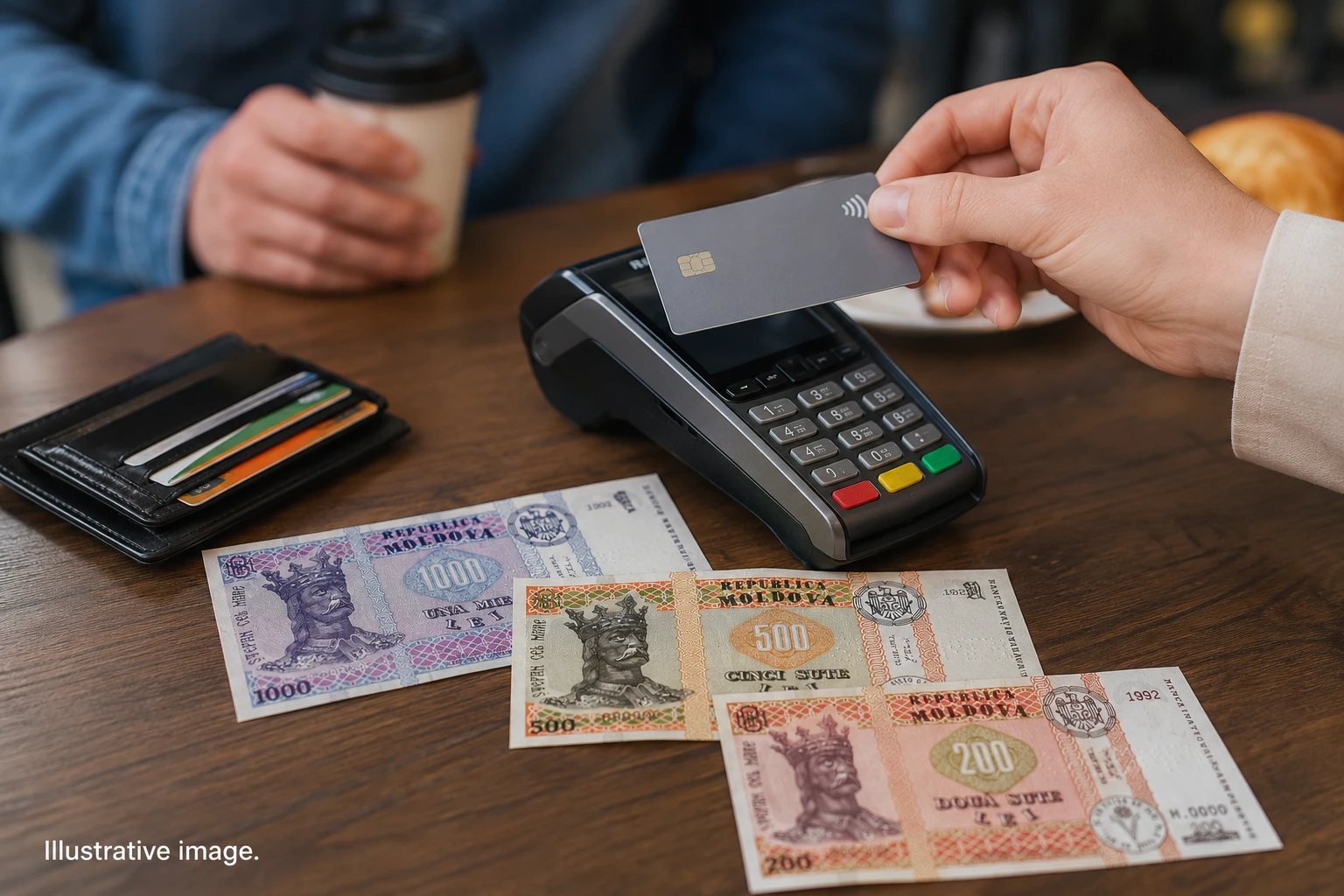
Bank cards issued in Moldova are already used much more frequently for payments than for withdrawing cash. In 2025, non-cash payments accounted for 90.9% of all card transactions recorded by the National Bank. But in terms of value, there was almost no difference: non-cash payments totaled 104.2 billion lei, while 104.4 billion lei was withdrawn as cash from cards. In other words, nine out of ten bank card transactions are payments, while cash withdrawals account for half of their total value.
Over the course of the year, holders of cards issued in Moldova made 310.1 million non-cash payments and 30.9 million cash withdrawal transactions. The difference is a tenfold ratio. However, the average amounts differ significantly. For domestic transactions, the average cashless payment in 2025 was 310 lei, while the average cash withdrawal was 3,376 lei. In other words, a single cash withdrawal is roughly equivalent in value to eleven typical non-cash payments.
At the same time, the gap is rapidly narrowing. In 2024, non-cash payments accounted for 45.4% of the total value of card payments and cash withdrawals, while cash withdrawals accounted for 54.6%. In 2025, the total value of non-cash payments rose by 30.2%—to 104.2 billion lei. The amount of cash withdrawn increased much more slowly—by 8.2%, to 104.4 billion. As a result, the ratio of roughly 45 to 55 in just one year has shifted to nearly 50 to 50.
The trend indicates that among people who use bank cards, the role of the card is rapidly shifting: from a tool for obtaining cash to a tool for direct payment.
At the same time, the card acceptance infrastructure is expanding. By the end of 2025, there were 55,900 POS terminals in Moldova, compared to 46,200 a year earlier—an increase of nearly 21%. Of these, 53,600 were located in retail outlets. While there were 8 POS terminals per 1,000 residents in 2019, by 2025 that number had risen to 23.
This is still far from European levels. According to data from the National Bank of Moldova (NBM), the EU average in 2024 was 52 POS terminals per 1,000 residents—more than twice as high as in Moldova. Furthermore, the infrastructure is unevenly distributed across the country: 57% of all POS terminals are located in the municipality of Chișinău.
The number of cards themselves is also growing. As of the end of 2025, there were 4.21 million payment cards in circulation—12.2% more than a year earlier. The penetration rate reached 1.8 cards per resident, compared to the EU average of 2.3 cards according to 2024 data.
However, just because a card has been issued does not mean it is being used. The NBM considers cards to be active if at least one financial transaction was made with them during the quarter. At the end of the year, there were about 2.5 million such cards, or 59.4% of the total. Another 1.71 million cards (40.6%) remained inactive.
Therefore, the frequency of payments is a more telling indicator. In 2020, there were an average of 27 non-cash card payments per year per Moldovan resident. By 2025, that number will reach 130. Over five years, the figure has increased nearly fivefold. But even here, the gap with the EU remains large: the average European level, as reported by the NBM for 2024, is about 240 payments per person per year.
E-commerce is growing even faster. In 2025, 40.1 million payments totaling 18.4 billion lei were made via e-commerce platforms using cards issued in Moldova. Over the course of the year, the number of such transactions increased by 42.8%, and their value rose by 36.5%.
However, the bulk of these transactions took place outside the country. A total of 33.1 million payments—82.4% of the total—were made on foreign e-commerce platforms, amounting to 14.9 billion lei, or about 81% of the total value. On platforms registered in Moldova, there were approximately 7 million payments totaling 3.5 billion lei.
The difference here is noticeable not only in absolute volumes but also in growth rates. The total number of e-commerce payments grew by 42.8% over the year, while on Moldovan platforms it grew by only 10.1%. In terms of value, the overall market grew by 36.5%, while payments through local platforms grew by 6.6%. It follows that the main growth in online spending by Moldovan cardholders is driven by transactions outside the domestic e-commerce market. Experts note that this is due to aggressive advertising by foreign marketplaces, such as Temu, AliExpress, and others, as well as the fact that Moldovan residents are very active shoppers on foreign marketplaces. This affects not only the growth in the number of cashless card transactions but also the growth of the postal market. More on this in another article in the InfoMarket – Expert section. //19.08.2026 – InfoMarket.