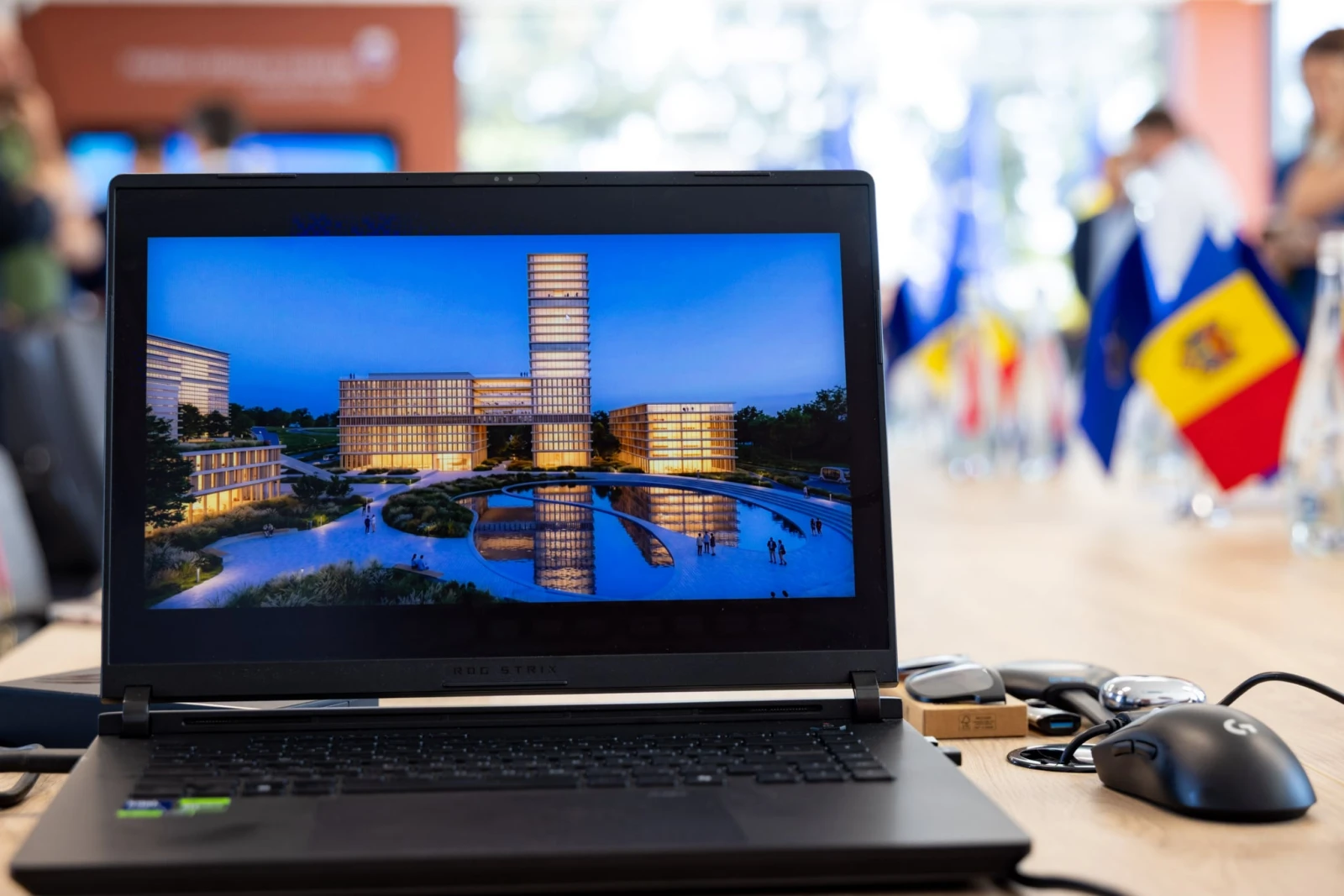
This was discussed during the presentation of the master plan for the future Moldova HiTech Park, a city-wide technology and innovation campus that will be built on a site of approximately 50 hectares in Stavcheni, near Arena Chișinău and the main access roads to the capital. The master plan outlines how the future park will be organized: where buildings, green spaces, and areas for companies, universities, research centers, startups, MedTech, GovTech, digital infrastructure, and high-tech manufacturing will be located. The document also outlines how the project will evolve over time as investments, residents, and new partners come on board. The event in Stavcheni was attended by representatives of central and local authorities, Moldova HiTech Park shareholders, development partners, universities, representatives of the business community, and potential residents of the future park. The master plan, developed by the Romanian architectural firm UNITH2B in collaboration with the Moldova HiTech Park team in a consortium with the local architectural firm Architects Group, with financial support from the German government agency GIZ, proposes the creation of a compact, green, and interconnected space where education, research, and business will be as close to one another as possible. The main idea is that people, companies, and institutions will be able to collaborate synergistically: students will be closer to laboratories, researchers will be closer to companies, and ideas will be closer to the market. The future campus will include zones dedicated to education and research, technology companies and startups, MedTech and HealthTech, GovTech and data infrastructure, as well as facilities for conferences, services, community activities, and high-tech manufacturing. One of the master plan's key concepts is compact development, including vertical construction. The goal is simple: less land occupied by buildings and more space for people, nature, and public areas. At least 40% of Moldova HiTech Park's territory will be allocated to green and public spaces. The concept includes pedestrian and bicycle paths, public transportation, meeting areas, and open spaces for the community. The master plan also incorporates the principles of the "sponge city"—a model of urbanism in which rainwater is collected, stored, and reused, rather than treated as a problem. Another important step will be the development of an urban transportation corridor between Moldova HiTech Park and the campus of the Technical University of Moldova on Studenților Street. This connection is important because it will directly link the park to one of the country's largest communities of students and engineers. One of the most important components of Moldova HiTech Park will be the MedTech and HealthTech zone: approximately 22% of the park's territory is reserved for this sector. This area will feature facilities for medical research, laboratories, medical technology companies, testing and modeling centers, medical robotics, and high-tech manufacturing. The idea is to enable doctors, engineers, researchers, and companies to collaborate more closely, allowing new solutions to reach the market faster—from research to testing and, ultimately, to commercialization. Following the presentation of the master plan, Moldova HiTech Park is moving on to the stage of preparing urban planning and technical documentation. This includes the development and approval of the Zonal Urban Development Plan, scheduled for spring 2027, as well as topographic and geotechnical surveys, the design of utility networks, and the coordination of access infrastructure solutions. The first phase of development will focus on basic infrastructure and the park's initial core, so that government investments can create the necessary conditions for gradually attracting private investment. Moldova HiTech Park is Moldova's first state-of-the-art technology park. The managing entity, Moldova HiTech Park LLC, counts among its founders the state, the local authorities of Stăuceni and Chișinău, the Technical University of Moldova, and the Nicolae Testemițanu State University of Medicine and Pharmacy. // 14.08.2026 — InfoMarket
A 50-hectare Moldova HiTech Park will be built in Stavcheny, creating 21,000 jobs
Moldova HiTech Park will create more than 21,000 jobs and contribute to the development of high-tech sectors