

We live in a world where ordering a cab takes two taps and confirmations land in milliseconds. We've grown used to everything being instant, everything one click away. And yet the moment we sit down at a restaurant table, that modern pace seems to stall completely. The menu has stayed a rigid, expensive-to-reprint object: outdated prices, dishes that sold out days ago, an average shelf life of just a few months before it's tossed out entirely, leaving behind waste nobody ever accounts for.
For a HoReCa entrepreneur, the classic paper menu has quietly become a steady drain on revenue: customers who hesitate because there's no photo, indecision in the face of a flat, uninspired description, orders lost simply because a dish was never given the chance to shine. But the real problem runs deeper: paper generates no data, and it can't tell an owner the one thing that actually matters – which dish sparks curiosity, and which one gets scrolled past. Sergiu Cașu, founder of Oto QR, remembers the exact moment this clicked for him. He was sitting at a table, an ordinary guest like anyone else, and it struck him how little restaurants actually know about their own customers' behavior. "All the waiter ever hears is the final decision. But everything that happens before that – what the guest looked at, what put them off, the price, the description – stays completely invisible to the restaurant," he says.
Without that data, restaurants end up making decisions blind, pulling items from the menu that were just badly positioned, and losing money without ever understanding why.
How Oto QR actually works
The team behind Oto QR, Sergiu Cașu and Adrian Moraresco, understood that digitizing a menu doesn't mean putting a clunky PDF on a phone screen that's already sitting on the table anyway. Their solution is more than a simple menu accessed through a QR code. It's an intelligent platform that turns customer behavior into data restaurants can actually use. After visiting more than 54 countries, comparing firsthand how restaurants in every corner of the world handle ordering and customer service, the founders set out to redefine the experience from scratch, building what's essentially a dynamic operating system for restaurant menus.
The platform digitizes a venue's entire catalog, offering automatic translation into more than 15 languages, illustrated with appetizing photos included as standard. It runs as a SaaS (Software as a Service) product: each restaurant builds its own menu, shapes it around its brand identity, and manages the whole thing from a phone. Guests can browse dishes in detail, add them to a cart, call the waiter over, or send an order straight to the kitchen. When they're ready to leave, they can request the check, pick how they want to pay, and even leave a digital tip directly for the waiter who took care of them – a feature with real impact on staff retention in an industry with notoriously high turnover, where tips still make up a meaningful part of income, especially now that over 70% of payments happen from a phone.
The system also automatically calculates and displays calories, ingredients, and allergens. For people with severe intolerances or food allergies, this technology prevents major health risks, ensuring automatic compliance with food safety regulations.
Feedback works just as efficiently: guests can rate the food, atmosphere, and service separately, and comments reach the venue manager instantly, along with details about the table and time. An unhappy guest who leaves a comment while still at the table gives the manager a chance to step in and fix the situation on the spot, before that frustration turns into a one-star review on Google Maps or a negative review on social media.
Data-driven optimization, with real results
"There was a dish sitting at position 12 on a partner restaurant's menu, the highest margin item on the entire list, the one actually driving their profit. When we analyzed the data, we found that over 78% of guests made their final decision after browsing only the first 9 items. We recommended moving that dish from position 12 up to position 4. Within a single week, orders for it had tripled. A printed menu will never surface an insight like that," says the Oto QR founder.
The platform's flexibility suits family businesses, new cafés, and large chains alike, as well as hotels, where the interactive menu goes directly into guest rooms, letting guests explore dishes and order room service from their phone without going down to the restaurant.
From recognition in Paris to global expansion
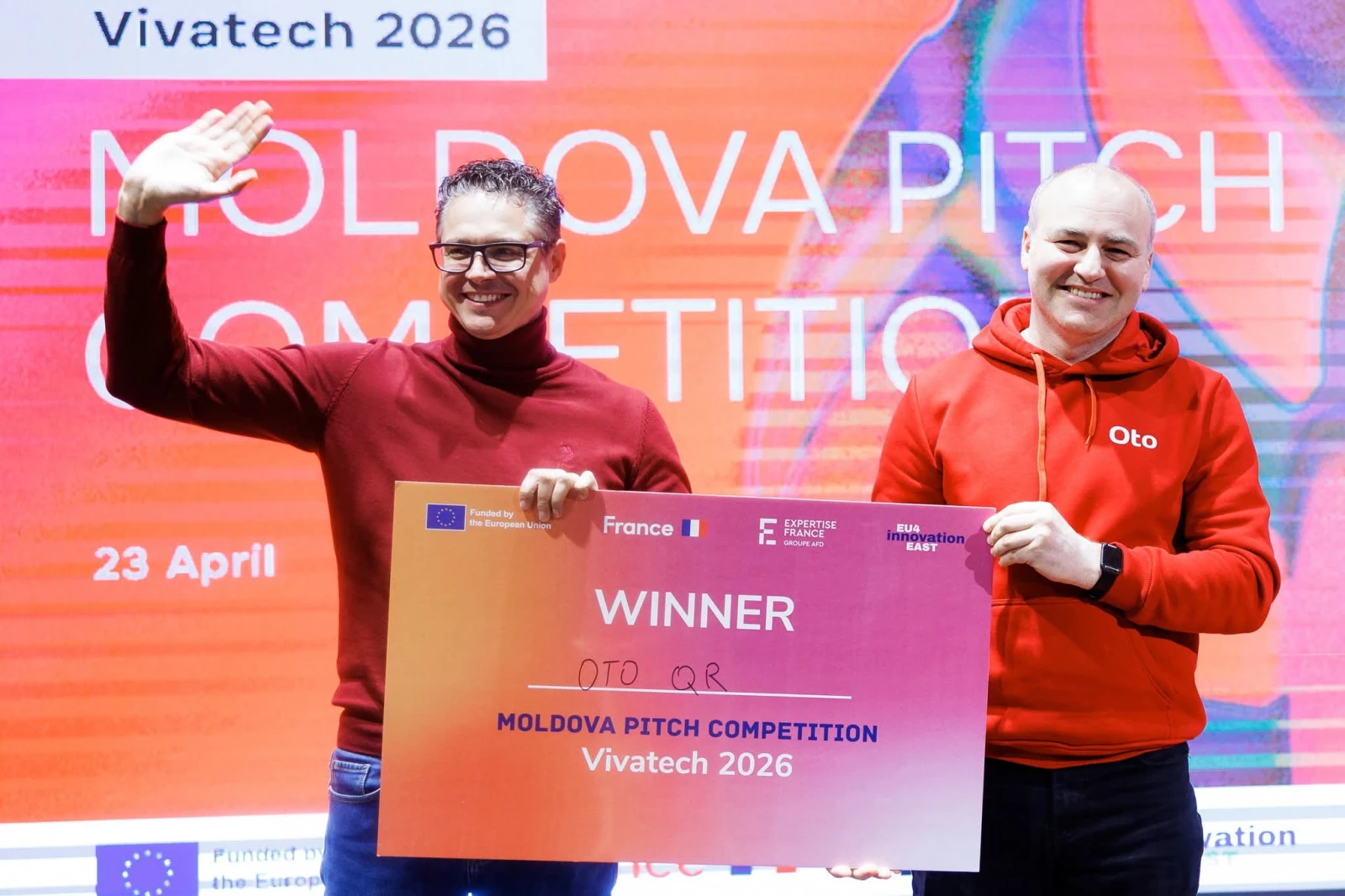
The project gained international validation after winning a national pitch competition run by EU4Innovation East, a regional project with a total budget of €23 million, funded by the European Union and co-funded by the French government, and implemented by Expertise France. Built to strengthen the tech ecosystem across the Eastern Partnership and raise the international visibility of startups from the region, the program became a genuine launchpad for Oto QR, opening the door to VivaTech 2026 in Paris, one of the most significant stages in global tech, where founders, investors, and innovators from every continent meet year after year.
Through EU4Innovation East, the team received full funding for the trip to Paris, intensive pitch coaching, and access to networking and strategic guidance from European experts, the starting point for their first real connections in the European market.
At VivaTech 2026, the team pitched on stage in the "EU4Innovation East Pitch Contest" alongside eight other regional startups. In a highly competitive lineup shaped by AI driven innovation, Oto QR placed 3rd, proof that a product engineered in Chișinău can hold its own alongside major European innovations.
"We realized that by building a local solution, for Moldova, it works just as well in France, Spain, Portugal, or Côte d'Ivoire. The problems we solve are universal," says Sergiu Cașu.
The team left Paris with valuable credibility and a valuable network of contacts. Feedback received directly from the international jury became the starting point for a new product direction, an AI based executive reporting module now in development, and the discussions held there opened new doors commercially, with more opportunities to build partnerships in the French market. "At VivaTech we understood exactly where to take the product next. We had advanced talks with a Paris based network that supplies restaurants, about representing and promoting us in the French market," Sergiu explains.
Follow the startup's full journey at VivaTech 2026 in the special feature.
Interest sparked by the Paris participation was felt immediately after returning home: a video about the team's journey at VivaTech 2026 went viral online, triggering a wave of inquiries from restaurant owners eager to bring the technology into their own venues. Shortly after, the startup won 1st place and the Grand Prize, worth 100,000 MDL (approximately €5,000), at the "Creative Post Accelerator" 2026 competition, organized by Yep!Moldova and funded by the Ukraine Moldova Enterprise Fund (UMAEF).
The team's next step in their global expansion will be participating in Web Summit in Lisbon, Portugal, another major stage of global innovation. The Oto QR team will go there with continued support from the EU4Innovation East project and other partners, representing the country at the national stand and continuing the international scale up process.
What's next for Oto QR
The founders keep building the app by closely listening to their customer community, turning suggestions coming directly from restaurant floors into new features. Coming up next, Oto QR is preparing dual synchronization with restaurant POS (Point of Sale) systems, the software restaurants use to manage their operations: automatic kitchen stock updates on the customer's screen, along with its own module for pre orders, online orders, and delivery, which spares restaurants the high commissions.
The AI based smart reporting module, shaped directly by feedback gathered in Paris, is now taking concrete form: it will automatically process each restaurant's scanning data and send weekly and monthly recommendations for boosting sales, cutting waste, and optimizing costs.
With bags already packed for Web Summit, the major event in Lisbon, and with events in Romania and Finland also on the calendar, Oto QR has the same goal: to prove that a solution with Moldovan DNA has everything it takes to become a new European standard.