


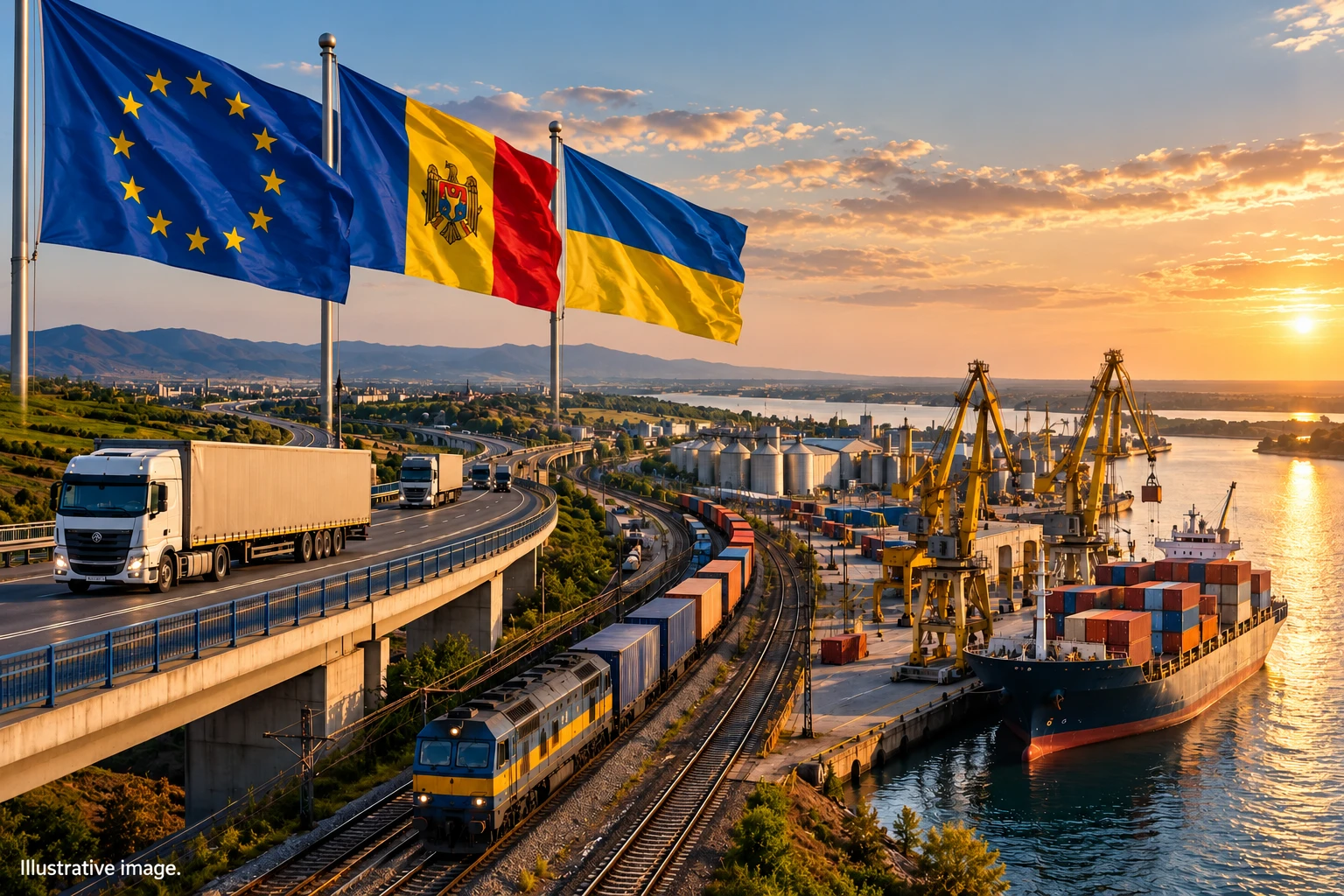
Moldova is once again highlighting the potential to turn its geographic location between the European Union and Ukraine into an economic advantage. At the Logistics Forum, held for the first time as part of Moldova Business Week 2026, participants discussed the prospect of transforming the country into a regional logistics hub, developing intermodal transport, and harnessing the potential of the Giurgiulești Port. At the same time, forum participants acknowledged the main obstacles: fragmented infrastructure, limited intermodal transport capabilities, regulatory barriers, and a lag in digitalization.
There is a more fundamental question regarding this idea: why should cargo from the European Union travel to Ukraine via Moldova at all, when Romania and Poland share a border with Ukraine?
For a significant portion of freight flows, the answer is simple: there's no reason to. If cargo is being shipped from Poland to western or central Ukraine, the route through Moldova would be a pointless detour. The same applies to much of the cargo from Romania, which can cross the Ukrainian border directly. Geographical location alone does not make a country a transit hub.
But logistics are determined not by a political map, but by specific points of origin and destination, the capacity of border crossings, and the availability of different modes of transport. And this is where Moldova finds its niche.
First and foremost, this includes southern Ukraine, the Odesa region, and the Danube corridor. The European Commission classifies Galați-Giurgiulești as part of the EU-Ukraine "Solidarity Lanes" Danube Corridor and identifies it as part of the busiest of these routes. In November 2024, Romania and Moldova signed a memorandum on coordinated border control at the Galați-Giurgiulești crossing specifically to expedite the movement of cargo from Moldova and Ukraine.
A telling example emerged in September 2026. On September 1, Romanian customs temporarily suspended operations at the Isaccea-Orlivka direct crossing between Romania and Ukraine due to security concerns. Carriers were officially offered the Galați-Giurgiulești and Oancea border crossings as alternatives, with onward transit through Moldova. By September 3, the Isaccea-Orlivka crossing had resumed operations, but this incident demonstrated the practical value of the Moldovan route as an alternative when direct connections between Romania and Ukraine are disrupted.
However, the additional border crossing remains a drawback. A truck must enter Moldova from Romania and then enter Ukraine from Moldova. This entails border checks, the risk of queues, additional transportation costs, and dependence on the throughput capacity of two border crossings.
As of November 2025, part of this drawback has been eliminated. Moldova has acceded to the Convention on Common Transit and joined the NCTS system. Now, cargo can travel through several countries using a single electronic transit declaration and a single guarantee, without having to re-file a complete set of customs documents at each border. Import duties and taxes are not paid while passing through a transit country; instead, their application is suspended until the goods reach their final destination.
Thus, the cost of the Moldovan route is determined primarily by time, transportation operating costs, road and related fees, and the risk of delays.
However, transit alone does not make a country a logistics hub. If cargo merely passes through Moldovan territory, the domestic economic impact is limited. It increases when the country develops warehouses, terminals, intermodal transshipment between rail, road, and port, freight forwarding, repairs, insurance, and other services.
Therefore, what matters for Moldova is not only the volume of cargo passing through its territory, but also what part of the logistics chain it can serve within the country.
The most obvious location for such a model remains the Giurgiulești hub. This is where the Moldovan, Romanian, and Ukrainian transportation systems converge; it features road and rail connections and access to the Danube. This allows not only for the transit of cargo but also for its redistribution among different modes of transport.
For Ukraine, the value of such a hub lies primarily in providing an additional route to European and Danube infrastructure. Since the start of the war, the stability of logistics has come to depend not only on the length of the route but also on the availability of alternative routes. The closure or congestion of a single crossing can quickly alter the flow of cargo, and Moldova can serve as an alternative corridor in such a system.
There is also a separate domestic market. Moldova itself imports and exports goods, and its businesses need warehouses, modern terminals, container transport, and more efficient connections to Romanian ports and the European rail network. Therefore, some investment in logistics infrastructure can be justified even without significant international transit traffic.
The real market for Moldova is southern and southwestern Ukraine, the Odessa region, the Danube corridor, and cargo for which transshipment in the Giurgiulești area is advantageous, alternative routes in case of congestion or closure of direct crossings, as well as the country's own import and export flows.
The idea of a logistics hub makes economic sense, but Moldova's niche is quite narrow. The country could become an essential link where a direct route is congested, inaccessible, or less convenient. And then its geographic location ceases to be just a dot on the map and begins to generate revenue. // 07.10.2026 – InfoMarket.