The government approved the declaration of a state of emergency in the energy sector throughout Moldova for 60 days, starting March 25
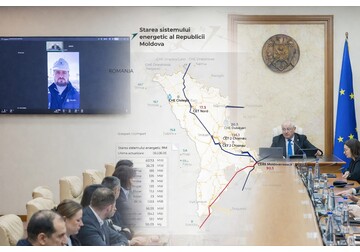
In accordance with legal procedure, this Cabinet decision requires formal approval by Parliament, which will consider the matter at an extraordinary plenary session on Tuesday evening. The declaration of a state of emergency in the energy sector throughout Moldova was approved by the government at an extraordinary session on Tuesday, following a meeting convened that morning on the platform of the National Crisis Management Center, at the request of the Ministry of Energy. As noted, following Russia's attacks on energy infrastructure in southern Ukraine, the operation of the damaged 400 kV Vulcanesti-Isaccea overhead power line was suspended. The decision is based on a risk analysis, the need for urgent measures to protect critical infrastructure, and the mobilization of additional resources. Following the incident, which occurred at 7:15 PM on March 23, the transmission line operator, Moldelectrica, immediately activated security protocols. Attempts to automatically reconnect, or restore service on the line, were unsuccessful. Technical faults detected in the conductor supports in Ukraine indicate a serious short circuit requiring specialized intervention. The Vulcanesti-Isaccea 400 kV transmission line is the main backbone of the ENTSO-E power system, the European network coordinating transmission system operators in Europe. It typically supplies 60% to 70% of the consumption on the right bank of the river in Moldova. Current flows in this direction are 0 MW, which is estimated to lead to a deficit of up to 350-400 MW during peak hours, starting tomorrow. Even if the system is currently operating stably by using 110 kV lines in island mode and reconnecting the 330 kV Balti-Dnistrovsk transmission line, these resources are limited and can only cover a portion of national needs. Furthermore, the restoration of the Vulcăneşti-Isaccea power line is hampered by the discovery of debris from downed drones near damaged infrastructure on the Ukrainian side, necessitating demining operations before technical crews can safely begin work. As the National Crisis Management Center noted, in this context, declaring a 60-day state of emergency in the energy sector is not just a formality, but a legal mechanism providing the necessary leverage to prevent large-scale damage to the system. Firstly, it allows for prompt decisions to be made regarding the provision of energy resources, including by deviating from standard procurement rules to ensure the continuity of supply to citizens. Secondly, it provides the basis for the immediate allocation of funds necessary for the purchase of energy supplies and emergency equipment. Thirdly, it allows the government, if necessary, to order the rationalization of consumption and the introduction of special operating rules for economic operators in order to protect critical economic objectives and social institutions. At the same time, this regime facilitates centralized strategic coordination through the National Crisis Management Center, ensuring constant communication with partners in Romania and Ukraine and the accurate dissemination of necessary austerity measures to the public. Herewith, technical teams continue ongoing monitoring and on-site inspections. "This measure is a national security measure aimed at limiting the impact of the crisis and ensuring the functioning of vital services—healthcare, social services, public order, and others," the Cabinet emphasized. Prime Minister Alexandru Munteanu, during an extraordinary Cabinet meeting, noted that the military conflict is leading to strikes on the neighboring country's critical infrastructure, causing a chain reaction throughout the region and directly affecting Moldovan citizens. Drone attacks, for example, led to the shutdown of the main power line supplying Moldova—the Isaccea-Vulcanesti line. Four interconnection lines with Romania were activated, but the situation remains challenging. As Alexandru Munteanu noted, rolling blackouts are still possible. And, unfortunately, the risk of further attacks on infrastructure cannot be ruled out. "We have real risks to the country's energy security," the Prime Minister said. He noted that, furthermore, developments in other regions, including the Persian Gulf, are putting pressure on global energy markets. "In this context, our response must be unambiguous. To manage the situation, quickly mobilize resources, and maintain vital services, I propose declaring a state of emergency in the energy sector for 60 days," the prime minister said. He announced that, following the cabinet's decision, he would go to parliament to ask members of parliament to vote on declaring a state of emergency in the energy sector for 60 days. // 24.03.2026 — InfoMarket.