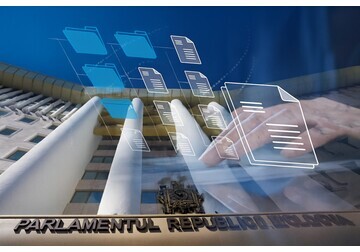
The Moldovan Parliament has passed in the first reading a bill that contains new measures to support the business environment
The legislative initiative was developed by a group of MPs from the Action and Solidarity Party parliamentary faction and aims to correct some of the identified shortcomings in the application of the regulatory framework and prevent financial blockages and distortions of competition. Another goal of the bill is to protect the business environment and public interests. The authors note in the explanatory memorandum that the implementation of the legislative proposals will ensure a more equitable, predictable, and investment-friendly regulatory framework that does not affect financial discipline and the interests of the state. The bill contains amendments to the Tax Code. The authors propose to establish a clear and limited exception to the suspension of account operations or the execution of amounts. The exception will apply only within the limits of the budgetary institution's debt to the taxpayer and within the framework of the approved appropriations for these purposes. Thus, the goal is to ensure fair treatment of taxpayers who must collect payments from budget-funded institutions and whose tax debt is determined by delays in fulfilling their payment obligations. The authors also propose to change the penalty for improper declaration of taxable income, which does not directly affect the state budget. Thus, the penalty will range from 1,000 to 10,000 lei, instead of 12-15% as it is now. Another proposal by the authors provides for the application of the customs regime of the final destination. In particular, a list of goods that can be imported into Moldova without paying customs duties will be introduced. The list will include raw materials that cannot be produced in our country but are necessary for production and processing in light industry and the agri-food sector. These include tropical fruit puree, concentrated lemon and pomegranate juice, palm oil, coconut oil, and unprocessed synthetic fibers made from polyester and polypropylene. Other provisions of the bill concern the creation of fair and effective conditions for economic operators participating in public procurement procedures. Thus, entrepreneurs will have the right to choose the form of establishment and payment of collateral in accordance with the options provided by law. Until now, economic operators were required to provide a bank guarantee, which directly affected the liquidity of entrepreneurs. At the same time, the authors propose to review the sanctions for violating the rules regarding the incorrect establishment of qualification criteria for participants in public procurement procedures, including in the documentation for awarding contracts. Thus, the penalty for restricting in any form the access of economic operators to public/sectoral procurement award procedures by establishing or applying criteria that contradict the law will reach 10,000 lei. Until now, the fine has ranged from 750 to 3,000 lei. The bill must be finalized and considered by parliament in the second reading. // 12.03.2026 — InfoMarket