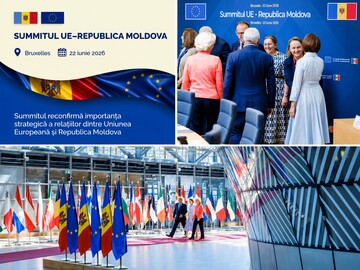
The European Union will provide Moldova with €528 million in financial support from the Reform and Growth Fund if our country maintains a sustainable pace and achieves all reform milestones planned for 2026
This was stated, among other things, in the joint declaration adopted following the 2nd EU-Moldova Summit held in Brussels on June 22. The document notes that the €1.9 billion Growth Plan for Moldova is already delivering tangible results and is helping bring our country closer to EU membership by accelerating reforms. EU and Moldovan leaders welcomed the allocation of pre-financing and two subsequent tranches of the Reform and Growth Fund, totaling approximately €504 million. It is emphasized that the Growth Plan will continue to support key institutional and regulatory reforms aimed at creating better jobs and opportunities, as well as supporting priority investment projects across the country. An additional €528 million in financial support from this fund will be unlocked if Moldova maintains its sustainable momentum and achieves all reform milestones set for 2026. The joint declaration notes that trade and investment between Moldova and the EU have grown significantly, benefiting businesses and consumers. Moldova’s economy is increasingly interconnected with the European single market, thanks to the Larger and Comprehensive Free Trade Area (DCFTA) under the EU-Moldova Association Agreement. Increased direct investment between Moldova and the EU contributes to the development of integrated value chains, structurally linking the economies. The parties welcomed the successful EU-Moldova Investment Conference held in Chisinau on 4 June, which demonstrated the commitment of business leaders to further economic integration. EU and Moldovan leaders also welcomed Moldova’s accession to the Single Euro Payments Area and the significant savings this brings for both people and businesses in Moldova and the EU. They also commended Moldova for its progress in strengthening its energy security. The impact of Russian attacks on critical regional energy infrastructure, as well as the crisis in the Middle East, highlight the need for continued efforts to enhance connectivity and move toward market interaction, develop well-functioning energy markets and diversify supplies, improve energy efficiency, and accelerate the development of local renewable energy sources. The EU and Moldovan leaders welcomed the launch of a project to improve the energy efficiency of buildings. They also noted that the completion and commissioning of the Vulcăneşti-Chisinau high-voltage transmission line will mark another important milestone in ensuring Moldova's energy security. The EU stated that it will continue to support Moldova in its efforts to diversify its energy sources, improve efficiency, independence, and interconnectivity with the EU, including through the Vertical Gas Corridor, with the aim of strengthening regional energy resilience and security of supply. The joint declaration states that the leaders of the European Union and Moldova, following the 2nd EU-Moldova Summit in Brussels on 22 June 2026, concluded that the partnership between the EU and Moldova continues to strengthen, based on the shared values of democracy, the rule of law and respect for fundamental human rights, international law, multilateralism and the rules-based international order. The summit reflects the depth of our partnership and the concrete benefits it brings to our citizens. We reaffirm that the future of Moldova and its citizens lies in the European Union,” the document emphasizes. The EU reaffirmed its unwavering support for Moldova’s sovereignty, stability, territorial integrity, and prosperity. The parties reaffirmed their commitment to advancing Moldova’s EU accession process rapidly, based on credible reforms and the merits principle, in line with the Copenhagen criteria. The EU called on Moldova to maintain the strong momentum of EU-related reforms, ensure their irreversibility, and continue to deliver benefits that are felt and recognized by all Moldovan citizens. The parties agreed to continue Moldova’s gradual integration into the EU internal market in key sectors and to ensure Moldova’s progressive participation in EU policies and programs already during the accession process, stressing the importance of maintaining Moldova's compliance with EU legislation. This will stimulate economic growth, benefit citizens and businesses, strengthen resilience and convergence, and enhance Moldova's readiness for EU membership. EU and Moldovan leaders emphasized the crucial role of transport connectivity in deepening EU-Moldova integration, including through Moldova's gradual accession to the Trans-European Transport Network (TEN-T) and the operationalization of Solidarity Corridors. They emphasized the significant mutual economic benefits of the EU-Moldova Road Transport Agreement and further investments to support the rehabilitation of TEN-T infrastructure. In this context, efforts to advance Moldova's integration into the Single European Railway Area, the deployment of EU standard-gauge railway infrastructure, and the modernization of the Ungheni-Chisinau railway line were identified as key steps. The EU stated that it highly appreciates Moldova's efforts to maintain peace and stability on both sides of the Dniester River, as well as the steps taken by the Moldovan government to gradually bring the two rivers closer together. The EU remains committed to actively supporting the country's comprehensive, peaceful, and lasting reintegration. The EU stated that it will accelerate and deepen its comprehensive engagement with Moldova, including, in particular, through regular EU-Moldova summits.// 22.06.2026 – InfoMarket.