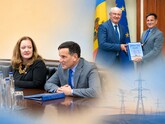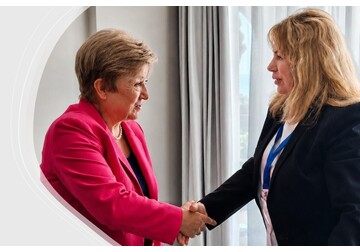
NBM Governor Anca Dragu and IMF Managing Director Kristalina Georgieva discussed Moldova’s cooperation with the IMF, the evolution of macroeconomic indicators, and the continuation of reforms necessary for the country’s path toward Europe
In particular, the head of the National Bank of Moldova (NBM) welcomed the agreement reached at the expert level with the International Monetary Fund on the new Policy Coordination Instrument. Anca Dragu highly commended the efficiency and professionalism of the IMF team throughout this process. She emphasized that cooperation with the IMF, including under the Policy Coordination Instrument, remains important for strengthening macroeconomic stability, reinforcing the institutional framework, and supporting the reforms necessary for Moldova’s European path. The NBM Governor noted that Moldova has a stable macroeconomic foundation, and the financial sector remains resilient, well-capitalized, and has an adequate level of liquidity. At the same time, amid geopolitical uncertainty, the National Bank continues to closely monitor international developments and the potential impact of these trends on the national economy. During the meeting, Anca Dragu also emphasized the importance of the technical assistance provided by the IMF in strengthening the NBM’s institutional capacity. Priorities are focused, in particular, on implementing the recommendations of the Financial Sector Assessment Program, strengthening the financial stability framework, developing macroprudential policy, modernizing the monetary policy framework, and advancing reforms in the areas of preventing and combating money laundering and terrorist financing. Another topic of discussion was the modernization of the payment infrastructure. The NBM Governor highlighted Moldova’s progress in connecting to the Single Euro Payments Area (SEPA), as well as the development of the national instant payment system MIA, created by the NBM. These projects help reduce costs, increase transaction efficiency, and bring Moldova closer to the European financial infrastructure. In the case of SEPA, the benefits are already evident for citizens and businesses. In the first 10 months since its launch, the use of SEPA transfers has saved Moldovan citizens more than 10 million euros. This result demonstrates the tangible impact of integration into the European payment infrastructure: more affordable services, lower costs, and more efficient financial links with the EU. At the same time, the MIA system—which quickly became a regional benchmark—has established itself as a modern infrastructure for payments in lei, offering the ability to conduct instant transactions 24/7 between individuals, companies, and government agencies. By developing these tools, Moldova is moving toward creating a faster, more transparent, and more accessible payment system. Another topic of discussions was the NBM’s contribution to the implementation of the Reform Program associated with the European Union’s Growth Plan for Moldova. The NBM is contributing to this process by consolidating financial legislation, developing the capital market, modernizing the regulatory framework, and strengthening economic governance. The NBM Governor reaffirmed the institution’s commitment to further aligning national legislation with European and the highest international standards in the financial sector. In this regard, the NBM aims to advance the process of recognizing the equivalence of Moldova’s prudential banking system with European Union standards, which is a crucial step toward strengthening confidence in the national banking system and reducing investment risks. Anca Dragu emphasized that these achievements support the implementation of measures undertaken as part of Moldova’s National Program for EU Accession and strengthen the foundation for accelerating European integration. At the same time, the proposed reforms should bring tangible benefits to citizens and businesses, ranging from stability and financial protection to broader access to modern services, expanded economic opportunities, and an improved quality of life. // 22.06.2026 – InfoMarket.