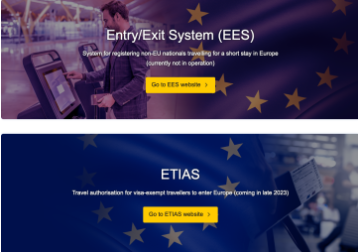
Citizens of Moldova and other countries with visa-free travel to the European Union will have to register with the ETIAS system once every 3 years and pay a fee of 7 euros starting November 2023.
As noted on the website https://travel-europe.europa.eu/, the rules of travel to Europe have changed, and from the end of 2023, about 1.4 billion people from more than 60 visa-free countries must have a permit to enter most European countries. The ETIAS (European Travel Information and Authorization System) travel permit is a requirement for visa-free citizens traveling to any of these 30 European countries. It is tied to the traveler's passport and is valid for up to 3 years or until the passport expires, whichever comes first. A new ETIAS travel permit must be obtained when getting a new passport. With a valid ETIAS travel permit, citizens can enter these European countries as often as they want for short stays - usually up to 90 days in any 180-day period. However, this does not guarantee entry. Upon entry, the border guard will ask to see the passport and other documents and check that one meets the conditions of entry. One can apply for an ETIAS travel permit by filling out an application form using either the official ETIAS website or the ETIAS mobile app. It costs €7 to apply for an ETIAS travel permit, although some travelers are exempt from paying this fee. Most applications are processed within a few minutes. However, it is possible that it may take longer to process the application. If so, one may receive a decision within 4 days. This period may be extended up to 14 days if the citizen is asked for additional information or documentation, or up to 30 days if invited for an interview. Therefore, it is recommended to apply for the ETIAS travel permit well in advance. The citizen should receive an email confirming the application, which will include his or her unique ETIAS application number, which should be kept for future reference. Once their application has been processed, they will receive another email informing them of the outcome. When receiving the ETIAS travel permit, one needs to make sure that the name, passport number and other information are correct: if there is any mistake, the citizen will not be allowed to cross the border. If the application is rejected, the email will indicate the reasons for this decision. It will also provide information on how to appeal, information on the competent authority as well as the appropriate deadline for appeal. The ETIAS travel permit is valid for 3 years or until the travel document used in the application expires, whichever comes first. European authorities say it is not a visa, but merely an automated system, similar to the ESTA used in the United States. But given that approval can be denied if a person appears in a database of, for example, Interpol or the border authorities of Schengen Agreement countries, ETIAS actually serves as a visa for Europe. About 95% of requests will be approved automatically, 3-4% will take longer (maximum 30 days), requiring checks, and 1-2% will require "manual processing". The EU wants to implement ETIAS for a number of reasons, which have been discussed since 2016. More and more people are visiting Europe: about 50 million individual visitors in 2021. The number of refugees and asylum seekers for various reasons, including persecution, war, economic benefits, etc., has increased dramatically in the past few years. Terrorist incidents have become more frequent and countries such as France, Belgium, Germany and Spain have recently been affected. Advances in electronic communications technology, as well as the use of the Internet by people around the world, have made the electronic advance travel permit form a realistic and practical way to obtain information that will prove useful to European border and security authorities. As previously reported, the European Union decided in principle back in 2016 to change the border crossing procedures for citizens of those states that are eligible for visa-free entry into the EU. In 2018, the European Parliament approved legislation setting the parameters of the new system, called ETIAS (European Travel Information and Authorization System). However, the launch of the system was postponed several times, including due to the need for additional funding and the approval of technical legislation, which was adopted only in 2021. Then Brussels expected that the ETIAS system could be launched from the beginning of 2022, but the date had to be postponed again. // 28.12.2022 – InfoMarket